
Top 10 Foam vs Air Mattress Camping of 2026 Sleep Picks
Avoid cold ground and sagging beds. Compare foam vs air mattress camping setups in November 2026 to secure thermal comfort and restful sleep.
 By Lexie Sachs
Updated October 5, 2026

Waking up with sore hips pressed against frozen tent ground ruins an outdoor getaway faster than unexpected rain. Cold soil saps body warmth through thin tent floors, turning uninsulated inflatable beds into cold chambers before midnight. Deciding between foam vs air mattress camping setups comes down to balancing overnight air retention against vehicle cargo room. Pure air chambers pack down small, yet dropping temperatures contract air volume and leave you sagging before morning. Dense foam structures maintain solid physical cushioning regardless of temperature swings, keeping your spine supported all night.
Manufacturer specifications show that self-inflating hybrid mats provide an impressive balance for car campers. Models combining four-inch high-density foam cores with stretch-knit polyester fabric achieve exceptional thermal insulation, boasting R-values from 9.5 up to 13.0 that stop conductive ground chill. Integrated rechargeable electric pumps and built-in foot valves eliminate exhausting lung power after long trail hikes. Roll-up memory foam mats offer puncture immunity, while compressible hybrid mattresses collapse easily for tight vehicle packing. Selecting the right sleep foundation transforms chilly backcountry nights into deeply restful sleep.
| Award | Product | AMG Score About AMG ScoreThe AMG Score is our own rating from 0 to 10, based on performance, design and build, ease of use, and value. It reflects independent research and is never influenced by manufacturers, retailers, or affiliate commissions. Learn more › | |
|---|---|---|---|
| Best Overall |
OGERY 6-Inch Inflatable Camping Sleeping Pad
|
9.2/10 | Buy |
| Best Value |
 Hikenture 4-Inch Self-Inflating Sleeping Pad |
9.2/10 | Buy |
 LLUAII 4-Inch Self-Inflating Sleeping Pad |
9.1/10 | Buy | |
| Best Premium |
 Lost Horizon Option3 4.5-Inch Full Self-Inflating |
8.9/10 | Buy |
| Best Budget |
 TaskStar 4-Inch Self-Inflating Camping Pad |
8.8/10 | Buy |
 Easthome 4-Inch Memory Foam Camping Mattress Pad |
8.8/10 | Buy | |
 Hikenture 4-Inch Self-Inflating Queen Sleeping Pad |
8.6/10 | Buy | |
 OGERY 3-Inch Self-Inflating Sleeping Pad with Foot |
8.4/10 | Buy | |
 CYMULA 3-Inch Memory Foam Camping Mattress Pad |
8.4/10 | Buy | |
|
Lost Horizon Option3 4.5-Inch Full Self-Inflating
|
8.3/10 | Buy |
OGERY 6-Inch Inflatable Camping Sleeping Pad
The OGERY 6-inch inflatable camping pad delivers extra-thick off-ground cushioning with an integrated foot pump and built-in pillow for cord-free campsite setup. Weighing 2.4 pounds and packing down compactly, it is a practical choice for solo tent campers, car sleepers, and weekend outdoor travelers.
Pros
- Substantial 6-inch thickness provides noticeable elevation compared to thin traditional camping pads.
- Integrated foot pump eliminates the need for external pump hardware, cords, or batteries.
- Side connection buttons offer easy modular pairing with a second pad for camping couples.
- Packable 2.4-pound construction rolls into a compact, space-saving travel size.
Cons
- Lacks an official ASTM R-value rating, which may require pairing with an insulated foam pad on cold ground.
- Initial fabric relaxation and dropping overnight temperatures can reduce internal firmness, requiring a brief foot-pump top-off.
- Foot pump mechanism requires continuous manual stepping, which takes more physical effort than an electric pump.
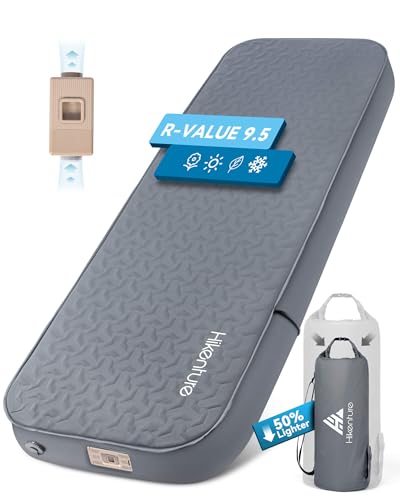
Hikenture 4-Inch Self-Inflating Sleeping Pad
The Hikenture 4-Inch Self-Inflating Sleeping Pad combines a plush 4-inch foam core with an automated electric pump for 90-second setup and quick push-button deflation. Featuring a listed 9.5 R-value and soft stretch-knit fabric, it is an excellent match for car campers and tent sleepers seeking dependable cold-ground warmth.
Pros
- Built-in electric pump provides hands-free 90-second inflation and automated deflation suction
- Deep 4-inch foam core cushions hips and shoulders effectively for side sleepers
- High listed R-value of 9.5 offers serious insulation against cold and damp ground
- Stretch-knit fabric surface reduces disruptive rustling and rubbery squeaks
- Generous 80-inch by 28-inch footprint provides ample room for taller outdoor sleepers
Cons
- Weighing 5.4 pounds, it is suited for car camping and vehicle setups rather than ultralight backpacking
- Relies on a built-in motorized pump mechanism that must be charged and maintained for off-grid setup
- Wide 28-inch single profile takes up considerable floor space inside narrow two-person backpacking tents
LLUAII 4-Inch Self-Inflating Sleeping Pad
The LLUAII 4-inch self-inflating camping pad pairs a plush, high-density foam core with a removable 1200mAh electric pump for effortless campsite setup. Offering a listed 9.5 R-value and a 600-pound weight capacity, it is a prime choice for car campers, truck bed sleepers, and cot users wanting deep comfort without wrestling manual valves.
Pros
- Detachable 1200mAh rechargeable pump eliminates the sweat of foot pumping or manual lung blowing
- Generous 4-inch thick foam core provides excellent pressure relief and body contouring for side sleepers
- Listed 9.5 R-value delivers top-tier thermal insulation against frigid tent floors and cold truck beds
- Internal TPU coating provides reliable moisture resistance and reduces noisy fabric squeaks when shifting positions
- Substantial 600-pound maximum weight capacity offers reliable structural support
Cons
- At 24 x 12 inches deflated, it is strictly intended for vehicle-supported camping and not suitable for backpacking
- Requires a 30-plus minute resting period after first inflation to allow vacuum-compressed foam to fully rebound
- Single 26-inch width may feel restrictive for restless sleepers who shift across wide angles
Lost Horizon Option3 4.5-Inch Full Self-Inflating
The Lost Horizon Option3 is a plush 4.5-inch Full self-inflating mattress that combines 12 pounds of internal foam filling with customizable air support and an outstanding R-value of 13. It is ideal for car campers, overlanders, and couples who want quiet, four-season warmth and support without the bouncy noise of standard air beds.
Pros
- Generous 4.5-inch thickness paired with 12 pounds of foam delivers exceptional pressure point relief
- High R-value of 13 ensures reliable thermal insulation for cold-weather and winter basecamp trips
- Substantially quieter and more stable than traditional hollow inflatable camping air beds
- Accommodates up to 440 pounds across an expansive 80 by 52-inch sleeping platform
Cons
- Heavy 16.1-pound total weight and bulky packed footprint make it strictly unsuitable for backpacking
- Manual deflation requires noticeable effort and patience to roll out without a dedicated pump
- Electric inflator/deflator pump is not included and must be purchased separately
TaskStar 4-Inch Self-Inflating Camping Pad
The TaskStar 4-Inch Self-Inflating Sleeping Pad pairs a supportive memory foam core with an electric pump that inflates the bed in roughly 90 seconds. With a listed 9.5 R-value and 440-pound capacity, it provides outstanding ground-cold isolation and plush support for car campers, overlanders, and tent sleepers.
Pros
- High listed 9.5 R-value offers strong thermal protection against frozen or cold campsite ground.
- Included electric pump handles both rapid inflation and active deflation without manual pumping.
- Generous 80 by 30-inch sleeping footprint accommodates taller campers and side sleepers comfortably.
- Soft 50D stretch-knit fabric remains quiet and crinkle-free when turning at night.
- Comes equipped with a dedicated foam-filled pillow, charging cord, and travel storage bags.
Cons
- At 30 inches wide, it requires a sizable tent footprint and may not fit narrow solo backpacking tents.
- Requires keeping the electric pump charged via the included cable prior to off-grid use.
- Hybrid memory foam construction naturally packs larger than ultra-minimalist uninsulated air pads.
Easthome 4-Inch Memory Foam Camping Mattress Pad
The Easthome 4-Inch Memory Foam Camping Mattress Pad provides dependable, puncture-free cushioning using a dual-layer foam core that completely eliminates overnight air leaks. Sized at 72 by 24 inches with an integrated pillow, it is an ideal non-inflatable sleep solution for car campers, cot sleepers, and tent campers.
Pros
- Completely eliminates middle sagging and midnight deflation caused by cold air contraction or slow valve leaks
- Generous 4-inch dual-foam thickness keeps sleepers cushioned above rocky ground, roots, and hard cot rails
- Full top-and-bottom waterproof coating keeps the internal foam completely dry on wet ground
- Comes complete with an integrated pillow, cinching straps, and an included zippered travel bag
Cons
- Heavier and noticeably more bulky when rolled than ultra-compact inflatable air mattresses
- Requires 24 to 72 hours in a warm room to fully expand after unboxing before initial campsite use
- Designed strictly for vehicle and car camping rather than human-powered backcountry backpacking
Hikenture 4-Inch Self-Inflating Queen Sleeping Pad
The Hikenture 4-Inch Queen Self-Inflating Sleeping Pad pairs high-density foam cushioning with an integrated electric pump for rapid 90-second campsite setup. Boasting a listed 9.5 R-value and a whisper-quiet stretch-knit top, it is an outstanding option for car camping couples and basecamp organizers seeking true cold-ground thermal protection.
Pros
- Generous 4-inch adaptive foam core provides plush cushioning against rocky terrain
- Exceptional listed 9.5 R-value delivers serious thermal insulation from freezing ground
- Integrated electric pump automates both rapid inflation and reverse-suction pack-down
- Soft stretch-knit top fabric prevents noisy rubber squeaks and movement rustle
- True Queen 80-inch by 60-inch dimensions comfortably accommodate two sleepers
Cons
- At 10.8 pounds, the unit is suited strictly for vehicle and basecamp use rather than backpacking
- Relies on a working electric pump mechanism for optimal hands-free setup speed
- Wide Queen footprint requires a spacious tent floor plan with low-angle wall clearance
OGERY 3-Inch Self-Inflating Sleeping Pad with Foot
The OGERY 3-Inch Self-Inflating Sleeping Pad pairs high-density foam cushioning with a built-in foot pump, delivering quiet insulation and steady support without needing an electric pump. It is an ideal sleep solution for car campers, tent campers, and cot sleepers looking for off-grid setup convenience.
Pros
- Integrated foot pump allows fast firmness fine-tuning without needing mouth inflation or electrical hookups
- High-density foam core deadens movement squeaks and insulates against cold ground surfaces
- Abrasion-resistant nylon construction paired with a textured non-slip bottom base
- Supportive three-inch thickness cushions pressure points for side, back, and stomach sleepers
Cons
- At 6 pounds, the pad is geared toward car and vehicle camping rather than ultralight backpacking
- Rolling up a dense foam-core self-inflating mat requires deliberate body weight to expel all trapped air during pack-down
- Manufacturer does not provide a reviewed ASTM F3340-18 laboratory R-value rating
CYMULA 3-Inch Memory Foam Camping Mattress Pad
The CYMULA 3-Inch Memory Foam Camping Mattress Pad delivers dependable, puncture-free comfort for car campers, tenters, and cot sleepers tired of midnight deflation. With high-density foam and a waterproof, non-slip base, it unrolls quickly without needing an air pump or vehicle power.
Pros
- Solid foam construction eliminates punctures, valve leaks, and overnight deflation entirely
- High-density three-inch memory foam cushions effectively over rocky ground or firm cot rails
- Waterproof, non-slip base prevents sliding on sloped nylon tent floors and blocks ground moisture
- Includes integrated compression straps and a dedicated carry bag for easy trunk transport
- Fiberglass-free safety construction with quiet, skin-friendly fleece fabric
Cons
- Packed roll-up volume is bulkier in vehicle cargo spaces than an ultralight deflated air pad
- Requires 24 to 72 hours after unboxing to expand, and may fall slightly shy of three inches if compressed for long periods
- Narrow 24-inch width fits cots neatly but may feel restrictive for broad-shouldered active sleepers
Lost Horizon Option3 4.5-Inch Full Self-Inflating
Built for serious basecamp comfort, the Lost Horizon Option3 combines a thick 4.5-inch profile with 12 pounds of supportive foam and an impressive R-value of 13. It is an ideal sleeping platform for car campers and overlanding couples who want quiet, reliable support without middle sagging.
Pros
- Plush 4.5-inch height and dense 12-pound foam core isolate sleepers from rough campsite terrain.
- Substantial R-value of 13 delivers reliable insulation against cold ground conduction year-round.
- Included portable pump achieves rapid deflation in roughly one minute.
- Silent foam and air combination prevents disruptive squeaks when shifting positions.
- Sturdy 440-pound weight rating offers solid support for two adults.
Cons
- Total weight of nearly 17 pounds makes it strictly suited for vehicle camping rather than backpacking.
- Large packed dimensions require dedicated storage space in your vehicle cargo area.
- Reaching maximum desired firmness may require extra manual air top-offs beyond unassisted self-inflation.
Frequently Asked Questions
Does cold weather make air mattresses sag more than foam pads during 2026 camping trips?
Yes, dropping night temperatures cause internal air to contract, creating noticeable sagging even without valve leaks. Foam pads maintain their structural thickness because open-cell foam does not rely on air pressure to support body weight. Hybrid self-inflating mattresses prevent this pressure drop by packing dense insulating foam inside airtight bladders. Campers facing frosty conditions get steadier firmness from foam-core foundations.
What R-value is required to block ground chill on cold campsites?
An R-value of 4.0 or higher suits three-season camping, while winter conditions demand ratings of 8.0 or above. Uninsulated airbeds circulate cold trapped air beneath your sleeping bag, pulling warmth away from your body. Hybrid pads featuring R-values between 9.5 and 13.0 block conductive ground frost completely. Selecting an insulated foam-core pad ensures consistent warmth on frozen ground.
How do packed sizes compare in the foam vs air mattress camping debate?
Inflatable and self-inflating pads compress far smaller than solid roll-up memory foam mattresses. Pure memory foam pads retain their physical bulk, taking up valuable cargo room in car trunks. Modern self-inflating mats use electric vacuum deflation to reduce packed volume by up to 85 percent. Campers with compact trunks benefit most from compressible hybrid designs.
Which mattress design provides better puncture resistance on rough tent floors?
Solid memory foam mattresses offer total puncture immunity because they lack airtight chambers. Inflatable mattresses made from 50D polyester with TPU coatings resist abrasions well, but sharp pine needles can still cause leaks. Using a durable ground tarp under inflatable pads adds critical protection. Campers setting up on jagged gravel avoid puncture risks entirely with solid foam.
How thick should a camping mattress be to prevent side sleepers from bottoming out?
Side sleepers need at least 3 to 4.5 inches of mattress thickness to cushion hip and shoulder joints properly. Thinner sleeping pads let pressure points press against hard ground, causing morning hip aches. High-density support foam combined with air chambers provides the necessary elevation to keep your spine aligned. Four-inch foam profiles distribute body weight evenly on uneven ground.
About the author
Lexie Sachs is a fiber scientist and experienced consumer-product evaluator with more than a decade of expertise reviewing mattresses and sleep products. Her work focuses on comfort, construction, durability, materials, performance and real-world consumer feedback to help shoppers make better-informed sleep purchases.