
What Size Batteries for Air Mattress Pump: Practical Guide for 2026
Find out what size batteries for air mattress pump models need in November 2026, from standard D-cells to portable USB-C rechargeable options.
 By Jeremy Klein
Updated October 13, 2026
Arriving at an unpowered campsite after sunset quickly highlights the importance of reliable inflation gear. When preparing a portable bed away from standard household wall outlets, understanding what size batteries for air mattress pump models require can save your trip from turning into an exhausting manual pumping ordeal. Traditional battery-operated airbed inflators almost universally rely on large D-cell alkaline batteries to drive their internal impellers, though some specialty compact pumps utilize C-cell batteries or internal rechargeable lithium-ion cells. If you find yourself in the woods without electrical hookups, knowing how to inflate an airbed at camp ensures you have the exact power source packed before leaving home.
High-volume low-pressure motors demand substantial electrical current to push hundreds of liters of air per minute into an inflatable mattress. Standard AA or AAA household batteries simply cannot deliver the sustained amperage required to spin high-speed blower impellers against rising backpressure without dying in minutes. Choosing the correct battery size, whether you are loading heavy D-cells into a legacy inflator or switching to a modern USB-C rechargeable pack, directly dictates your mattress firmness and setup speed. Understanding these power specifications helps you avoid motor thermal shutdowns, flat mattresses, and frustrating middle-of-the-night battery failures.
| Award | Product | AMG Score About AMG ScoreThe AMG Score is our own rating from 0 to 10, based on performance, design and build, ease of use, and value. It reflects independent research and is never influenced by manufacturers, retailers, or affiliate commissions. Learn more › | |
|---|---|---|---|
| Best Overall |
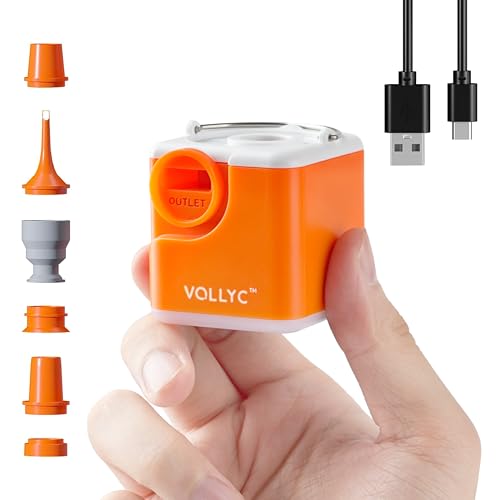
VOLLYC NANO-5 Cordless Mini Air Pump
|
9.2/10 | Buy |
| Best Budget |
 ETENWOLF AIR 3 Mini Air Pump |
8.8/10 | Buy |
| Best Premium |
 Dr.meter HT-420 Rechargeable Air Pump |
8.3/10 | Buy |
| Best Value |
 HYVOHEX 4000mAh Portable Air Pump |
7.8/10 | Buy |
VOLLYC NANO-5 Cordless Mini Air Pump
Weighing under 4 ounces, this pocket-sized cordless inflator pairs a 4.5kPa pump with a built-in camping lantern. It provides a convenient solution for campers and travelers packing light for sleeping pads and pool floats.
Pros
- Extremely compact and lightweight design
- Fast 200L/min flow rate for rapid inflation
- Built-in 3-stage camping light up to 250 lumens
- Includes six nozzles for varied inflatable valves
Cons
- Not suitable for tires, SUPs, or sports balls
- Max continuous run time limited to 10 minutes
ETENWOLF AIR 3 Mini Air Pump
Slightly larger than an egg, the ETENWOLF AIR 3 pairs a rapid low-pressure inflator with a bright 600-lumen camp lantern. It offers exceptional packability for backpackers needing quick sleeping pad inflation and campsite lighting in one lightweight unit.
Pros
- Ultra-compact design fits easily into pockets or packs
- Swift airflow handles rapid mattress inflation and deflation
- Multipurpose 600-lumen lantern with three brightness settings
- Comes with five nozzles for wide inflatable compatibility
Cons
- Cannot operate while connected to a charging cable
- Not suitable for high-pressure gear like SUPs or tires
- Low 0.65 PSI output limits high-pressure use
Dr.meter HT-420 Rechargeable Air Pump
Weighing under a pound, this cordless inflator delivers 250 liters of airflow per minute to quickly set up airbeds and pool toys. Its 4000mAh battery charges via USB-C and supports both inflation and deflation with three included nozzle fittings.
Pros
- Ultra-compact build weighing just 0.68 pounds
- Supports both inflation and vacuum deflation
- USB Type-C port allows easy mobile charging
- Three nozzle sizes fit common inflatable valves
Cons
- Runtime is limited to 25 minutes per charge
- 0.77 PSI pressure cannot fill high-pressure items
HYVOHEX 4000mAh Portable Air Pump
Built for quick gear setup, this palm-sized inflator delivers 360 liters per minute of airflow powered by a rechargeable 4000mAh battery. It serves campers and pool owners who need rapid inflation and deflation without manual pumping.
Pros
- High 360L/min airflow for rapid inflation and deflation
- Compact, lightweight design with 4000mAh rechargeable battery
- Fast two-hour USB-C charging time
- Includes three versatile nozzles for various valves
Cons
- Cannot operate while plugged in and charging
- Not compatible with high-pressure items like SUPs and tires
- Maximum continuous run time is 20 minutes
Guide to Battery Sizes, Power Demands, and Modern Airbed Pumps
Traditional battery-operated air mattress pumps almost universally require four D-size batteries to power their internal electric blowers. These large 1.5-volt cylindrical dry cells provide the sustained electrical current needed to drive high-volume impellers without rapid voltage collapse. A smaller subset of ultralight inflators uses C-cell batteries, while many contemporary portable pumps now replace dry cells entirely with sealed, rechargeable lithium-ion battery packs. Pinpointing the exact power requirements of your specific pump ensures you achieve adequate mattress firmness without getting stranded with depleted cells.
Why Most Traditional Dry-Cell Pumps Require D Batteries
Electric air mattress pumps do not work like low-drain electronic devices such as television remotes or wall clocks. Instead, an airbed pump utilizes a high-volume, low-pressure turbine impeller that pulls significant electrical current continuously for several minutes. Standard D-cell batteries, also cataloged as LR20 alkaline cells, offer substantial chemical volume and low internal resistance. This design allows them to discharge several amperes of current steadily without suffering an instantaneous drop in output voltage.
Placing smaller AA or AAA batteries into high-drain motor circuits causes rapid voltage sag and generates excessive internal cell heat. Even though four AA batteries in series produce the nominal 6.0 volts required, their internal capacity is roughly one-fifth that of larger cells. If an inflator attempted to run on AA cells, the motor would spin sluggishly, struggle against mattress backpressure, and exhaust the cells before an airbed was half inflated. D batteries provide the physical bulk and chemical reserves necessary to deliver reliable airflow.
Most dry-cell inflators feature a battery compartment calibrated specifically for four D-cells arranged in a series circuit. This arrangement creates a 6-volt direct current power supply capable of generating between 0.4 and 0.8 PSI of pressure. That specific pressure threshold is ideal for expanding vinyl sleep surfaces while protecting internal welded coil baffles from stress fractures. When packing for an unpowered trip, bringing fresh alkaline D-cells ensures your pump motor maintains peak impeller velocity from start to finish.
Identifying Battery Markings and Proper Polarity Layouts
Inspecting the battery compartment housing reveals the exact cell requirements molded directly into the plastic casing. Manufacturers typically stamp raised lettering indicating “4 x D Cell,” “LR20,” or “UM-1” inside the battery bay or on the inner face of the removable lid. If the text has worn down through years of camping use, examining the physical diameter of the battery bays provides an immediate clue. A D-cell compartment measures approximately 34 millimeters across, which is noticeably wider than a 26-millimeter C-cell slot.
Battery orientation errors represent one of the most frequent reasons a portable inflator fails to turn on. Because air mattress pumps require a series connection, adjacent batteries must alternate their positive and negative orientations. The flat negative terminal of each battery should always compress the coiled metal spring or flexible metal contact tab at the base of the chamber. Meanwhile, the raised positive nub must make firm contact with the flat conductive plate on the opposite end.
Securing the battery access door requires equal attention to ensure electrical continuity under motor vibration. Many pump lids use a twist-lock collar or snap-down latch that presses the internal contacts tightly against the heavy cells. If the latch is loose or misaligned, the circuit breaks intermittently, causing the motor to sputter or shut down under load. Ensuring clean, debris-free contact plates prevents unwanted electrical resistance that wastes power as heat.
Alkaline Versus NiMH Rechargeable Cells in Pump Motors
Selecting between standard disposable alkaline cells and rechargeable nickel-metal hydride (NiMH) batteries involves an important electrical tradeoff. Disposable alkaline D-cells have a nominal voltage of 1.5 volts per cell, providing a robust 6.0 volts across a standard four-battery pump. In contrast, rechargeable NiMH D-cells carry a nominal rating of only 1.2 volts per cell. When four NiMH cells are loaded together, the pump motor receives just 4.8 volts, which directly reduces maximum motor rotational speed.
Lower operating voltage directly affects airflow volume and final inflation pressure. With 4.8 volts powering the motor, an inflator moves fewer liters of air per minute and may struggle to push past internal valve flappers as the mattress tightens. The resulting bed often feels soft or underinflated, requiring manual top-offs to achieve comfortable firmness. However, NiMH cells maintain a flatter discharge curve than alkaline batteries, meaning they sustain their lower speed consistently rather than steadily declining over time.
Campers who choose rechargeable D-cells often do so to reduce environmental waste and eliminate recurring battery purchases. If you decide to use NiMH cells, selecting high-capacity models rated between 8,000mAh and 10,000mAh provides the best results for outdoor setups. Standard alkaline cells remain the preferred choice for maximum inflation speed and firm mattress support, especially when filling tall double-height airbeds. Keeping a fresh set of alkaline batteries on hand serves as a reliable performance benchmark during critical setups.
Real-World Run-Time and Inflation Cycles per Set
Understanding real-world battery longevity prevents unexpected surprises when preparing sleeping quarters late at night. Under continuous operation, a fresh set of four premium alkaline D-cells generally provides between 30 and 45 minutes of active motor run-time. Because a standard single-height Queen airbed requires roughly three to four minutes to fill, one fresh set of batteries can typically inflate two to four mattresses before flow rates drop noticeably. After that point, the declining voltage noticeably slows the impeller, extending inflation times and yielding softer beds.
Raised double-height Queen and King air mattresses dramatically alter these power calculations. An 18-inch or 22-inch raised mattress contains more than twice the air volume of a traditional low-profile camping pad. Inflating these high-profile beds requires seven to ten minutes of continuous pumping against increasing backpressure. Under this heavy workload, a single set of D-cell batteries may only survive one or two full setups before becoming too weak to achieve firm support.
Using the deflation port also consumes precious battery reserves. Running the pump in reverse to vacuum-pack your air mattress flattens the vinyl completely, making it easier to fold into a duffel bag, but it draws just as much current as the inflation cycle. If you plan a multi-night camping excursion involving multiple beds, packing spare D-cells is an absolute necessity. Learning efficient techniques for pumping an airbed while camping helps conserve electrical energy across extended trips.
Modern Integrated Lithium-Ion Pumps Versus Disposable Cells
The outdoor gear market has largely evolved beyond bulky D-cell inflators toward compact, built-in rechargeable lithium-ion battery pumps. Modern cordless inflators, such as the VOLLYC Air Pump with its 2400mAh cell or the ETENWOLF AIR 3 featuring a 2600mAh battery, pack substantial airflow into handheld form factors. Higher-capacity models like the Dr.meter 4000mAh Rechargeable Air Pump and the HYVOHEX 4000mAh inflator offer extended runtimes without requiring heavy loose batteries in your travel pack. These sealed units charge via standard Type-C USB cables from power banks, vehicle sockets, or solar panels.
Weight and pack volume represent the most dramatic differences between these power architectures. Four alkaline D-cell batteries weigh approximately 1.2 pounds on their own, completely independent of the pump housing itself. By comparison, palm-sized lithium pumps weigh only a few ounces while delivering comparable or superior airflow speed. The ETENWOLF AIR 3, for example, delivers 360 liters per minute of airflow and 0.65 PSI of pressure while remaining compact enough to slip into a jacket pocket. This makes lithium inflators exceptionally practical for travelers who want to minimize gear bulk.
Lithium-ion cells also eliminate the recurring financial burden of purchasing expensive packs of disposable batteries before every camping outing. A 4000mAh internal battery, such as the unit found in the Dr.meter pump, provides roughly 25 minutes of continuous operation on a single charge. That capacity is sufficient to inflate several camping mats or handle multiple weekend bed adjustments without hunting for dry cells. However, when an internal lithium battery eventually drains in deep wilderness, you cannot simply drop in a fresh pair of store-bought cells unless you carry a portable power bank.
Motor Airflow, Pressure Limits, and Thermal Safety
Air mattress pumps operate on high-volume, low-pressure (HVLP) pneumatic principles designed to move large quantities of air rapidly at safe pressures. Most portable inflators generate between 200 and 360 liters per minute of airflow while maintaining operating pressures between 0.4 and 0.8 PSI (approximately 3.5 to 5.5 kPa). This low-pressure threshold protects delicate internal vinyl seams and welded baffle structures from excessive mechanical stress. It also prevents catastrophic blowouts that can permanently ruin an inflatable bed during setup.
Campers occasionally make the dangerous mistake of attempting to use high-pressure automotive tire compressors or workshop air lines on inflatable beds. A tire inflator is engineered to deliver high pressure, often exceeding 35 to 100 PSI, but it moves air at a pitifully low volume. Connecting a high-pressure compressor takes an excessively long time to fill a large mattress and can easily rupture internal coil baffles, creating massive herniated bulges in the vinyl. Sticking strictly to purpose-built HVLP pumps preserves mattress structural integrity and maintains warranty protections.
Thermal management is another critical operational factor when working with battery-powered motors. Compact electric pump housings lack large heat sinks and rely on passing airflow to cool internal motor windings. Most manufacturers recommend limiting continuous run-time to roughly 10 minutes, followed by a brief cooling pause. Allowing the motor housing to cool prevents thermal cutoff switches from tripping and protects internal solder connections from heat damage. This simple habit keeps both dry-cell and lithium inflators running smoothly across many seasons.
Matching Valve Adapters to Preserve Battery Output
Using the correct valve adapter nozzle is essential for maximizing battery efficiency and preventing motor strain. Portable pumps typically include a tree of stepped plastic friction nozzles designed to fit standard pinch valves, threaded Boston valves, and wide rapid-deflation ports. If an undersized nozzle is forced into a valve, air escapes around the collar, forcing the motor to run twice as long and wasting precious battery power. Conversely, an oversized nozzle restricts airflow, causing motor backpressure that drains battery current rapidly.
Threaded Boston valves and brand-specific mechanisms, such as Coleman Double Lock valves, require careful nozzle alignment to ensure airtight engagement. The nozzle must fully depress the internal rubber check-flapper to allow unrestricted air passage into the bed chamber. If the flapper remains partially closed, the motor whines at a high pitch while moving virtually no air into the mattress. Seating the adapter firmly with a slight twisting motion locks the connection against backpressure and ensures maximum airflow transfer.
Dual-action port flexibility also plays a vital role when packing gear down at the end of a trip. Moving the nozzle to the intake suction port allows you to pull all residual air out of the mattress chambers. A completely evacuated mattress folds flat along its original factory creases, sliding smoothly into its storage sack without aggressive wrestling. Using a properly fitted deflation nozzle completes this vacuum process in under two minutes, saving both time and remaining battery reserves.
Proper Storage and Cold-Weather Battery Care
Storing your air mattress pump properly between camping seasons prevents unexpected terminal corrosion and equipment failure. Leaving alkaline D-cell batteries inside a pump compartment during months of storage frequently leads to potassium hydroxide leakage. This caustic white crust corrodes copper contacts, weakens retention springs, and can permanently ruin electrical circuits. Always remove dry-cell batteries from the pump before placing gear into closets, basements, or outdoor storage bins.
Rechargeable lithium-ion inflators require slightly different storage protocols to maintain cell health. Storing lithium cells completely drained causes copper shunts to form inside the battery, rendering them unable to hold a charge in the future. Conversely, keeping them at 100 percent charge in a sweltering garage degrades chemical capacity over time. The ideal approach involves charging internal lithium batteries to roughly 50 to 70 percent capacity and storing them in a cool, climate-controlled environment.
Cold outdoor temperatures also impact battery performance significantly during autumn and winter outings. Sub-freezing temperatures slow the chemical reactions inside both alkaline and lithium cells, causing sudden voltage drops under motor load. If you are preparing for using an air mattress in cold weather, keeping your batteries or rechargeable pump inside an insulated cooler or sleeping bag until bed setup preserves their chemical warmth and ensures strong airflow.
Field Workarounds When Batteries Deplete Off the Grid
Finding yourself at a remote campsite with dead batteries or an uncharged inflator requires practical alternative solutions. Car campers can often utilize a 12-volt DC vehicle adapter cord to power their inflator directly from an auxiliary dashboard socket. These vehicle cords draw direct current from the car battery, delivering steady voltage that inflates beds rapidly without relying on dry cells. However, always ensure your vehicle socket is rated for 10 or 15 amps to prevent tripping internal automotive fuses.
Packing a manual double-action hand pump or foot bellows inflator provides the ultimate fail-safe backup for wilderness trips. Double-action manual pumps move air on both the push and pull strokes, allowing you to top off an underinflated bed or achieve firm sleep support without any electricity whatsoever. While manual pumping requires physical effort, having a compact hand pump tucked into your trunk ensures you never spend the night sleeping directly on cold, hard ground.
Choosing the right battery configuration ultimately comes down to balancing pack weight, convenience, and setup location. If your existing pump takes dry cells, stock up on fresh 4-pack D-cell alkaline batteries and always carry a spare set in your camping duffel. If you prefer to eliminate disposable batteries altogether, upgrading to a modern USB-C rechargeable inflator provides lightweight, reliable airflow wherever your travels take you.
About the author
Jeremy Klein is a sleep-product tester specializing in mattress evaluation, testing methodology and data collection. His experience across mattresses, pillows and bedding gives him a practical understanding of support, comfort, materials and performance factors that matter when comparing sleep products.