
How to Inflate Air Mattress With Tire Pump: Practical Guide for 2026
Learn how to inflate air mattress with tire pump equipment safely using nozzle adapters and duty cycle cooling steps for October 2026.
 By Lexie Sachs
Updated October 6, 2026
By Lexie Sachs
Updated October 6, 2026

Arriving at a campsite or setting up a temporary guest bed only to realize your dedicated air pump is missing creates an immediate logistical challenge. In an emergency, many travelers look for ways on how to inflate air mattress with tire pump equipment found in their vehicle trunk or garage. While automotive tire compressors and manual bike pumps can technically force air into an inflatable mattress, the mechanical differences between high-pressure tires and high-volume low-pressure airbeds require strict caution. Campers who regularly sleep outdoors often review how to blow up an air mattress while camping to prepare backup inflation options before hitting the road.
Tire inflators are engineered to produce high pressure above thirty pounds per square inch, while domestic air mattresses require large air volume at low pressures between 0.4 and 1.2 pounds per square inch. Trying to push air through standard mattress valves without correct tapered adapters can overheat small compressor motors, trip vehicle fuses, or damage vinyl welded seams. Learning the right adapter setups, motor duty cycles, and manual firmness checks lets you improvise safely when standard inflation equipment is unavailable.
| Award | Product | AMG Score About AMG ScoreThe AMG Score is our own rating from 0 to 10, based on performance, design and build, ease of use, and value. It reflects independent research and is never influenced by manufacturers, retailers, or affiliate commissions. Learn more › | |
|---|---|---|---|
| Best Overall |
TANSTRIDER 18-Inch Full Air Mattress with Built-in
|
8.6/10 | Buy |
| Best Value |
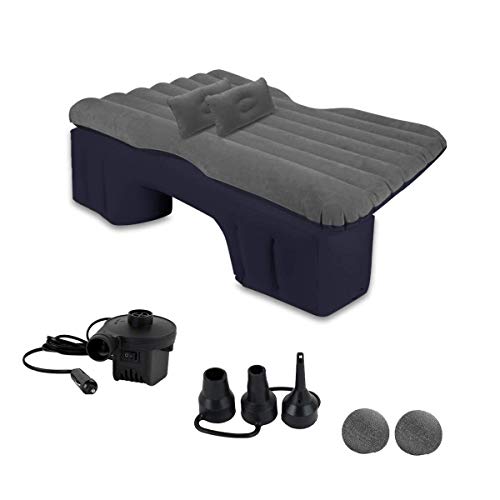 Zento Deals Universal Backseat Car Air Mattress
|
8.4/10 | Buy |
TANSTRIDER 18-Inch Full Air Mattress with Built-in
Featuring an integrated 120VAC electric pump running at 1.15A, this 18-inch TANSTRIDER full air mattress inflates and deflates in under 3 minutes. It provides a convenient, self-contained bedding setup for home hosts, overnight visitors, and temporary indoor living arrangements.
Pros
- Integrated 120VAC (1.15A) pump completes full inflation and active deflation in less than 3 minutes
- Robust 600-pound weight capacity with internal structural support distributes weight evenly across the bed
- Raised 18-inch height provides comfortable chair-height clearance for overnight guests
- Soft waterproof flocked top resists punctures and helps keep fitted full sheets in place
- Dedicated quick-deflate mode evacuates air flat for easy packing into storage closets
Cons
- Requires a standard 120V AC household outlet, making off-grid tent camping impractical without a compatible generator or power inverter
- Integrated pump design is permanently built into the mattress and cannot be detached to inflate secondary inflatables
- High-rpm internal electric motor produces noticeable operational sound during the 3-minute inflation cycle
Zento Deals Universal Backseat Car Air Mattress
The Zento Deals Backseat Air Mattress turns your vehicle rear seat into a quick resting platform, complete with an included pump, two pillows, and repair patches. Measuring 56 by 34 by 13 inches, it is an accessible, budget-friendly sleep solution for solo road trippers, festival-goers, and spontaneous car campers.
Pros
- Includes an inflator pump and nozzle kit directly in the package for hassle-free vehicle setup
- Comes complete with two matching inflatable pillows and two emergency repair patches
- Dedicated 13-inch profile bridges the rear footwell gap to create a level car-sleeping platform
- Smooth wipe-clean material makes maintaining hygiene simple after outdoor trips
Cons
- At 56 inches in length, taller adult campers will need to bend their knees or sleep at an angle
- Lacks listed R-value thermal insulation, requiring supplemental blankets or foam pads in cold weather
- Air volume naturally softens as evening vehicle cabin temperatures drop overnight
Adapting a Tire Pump for Air Mattress Inflation
Using a tire pump to inflate an air mattress is entirely possible during emergencies, but the process requires an understanding of pneumatic volume and pressure differences. A standard automotive tire inflator functions fundamentally differently than a dedicated low-pressure airbed blower. You can achieve a full, sleep-ready mattress if you utilize the correct nozzle adapter and monitor inflation pressure closely. Doing so prevents motor burnout and protects internal vinyl baffles from catastrophic failure.
High-Pressure Tire Pumps versus Low-Pressure Airbed Dynamics
Tire inflators belong to the high-pressure, low-volume equipment category, engineered to compress small air pockets up to several dozen pounds per square inch. In contrast, inflatable airbeds require high-volume, low-pressure airflow that gently fills large chambers without stressing seams. Airbed materials rely on structural air distribution rather than dense compression. Applying a tool designed for rigid rubber tires to flexible polyvinyl chloride bedding introduces immediate mechanical mismatch.
Airflow velocity differences highlight why the inflation process takes considerably longer with tire equipment. Dedicated airbed blowers commonly push between three hundred and six hundred liters of air per minute into an inflatable mattress. A compact 12-volt vehicle tire compressor typically delivers between ten and thirty liters of air per minute. Because the volume delivery is so restricted, filling an entire full-size or queen-size mattress with a tire compressor can take anywhere from twenty to forty-five minutes.
Internal airbed baffles are vulnerable to pressure spikes that tire inflators can easily generate. Most domestic and camping airbeds use internal coil beams or welded vinyl trusses rated for maximum operating pressures between 0.4 and 1.2 pounds per square inch. A small automotive compressor can effortlessly produce forty to eighty pounds per square inch if airflow meets resistance. If air cannot distribute rapidly through the mattress chambers, localized pressure can tear internal welds and create bulging deformities.
Essential Valve Adapters and Mechanical Connections
Tire inflators feature chucks configured specifically for threaded brass Schrader valves commonly found on vehicle tires and bicycle tubes. Air mattresses utilize entirely different valve geometries, including threaded wide-mouth Boston valves, pull-out pinch valves, and push-in stopper plugs. You cannot simply press a bare brass tire chuck against a large mattress opening and expect air to transfer efficiently. A mechanical adapter must bridge the gap between the narrow compressor nozzle and the broad airbed intake port.
The most effective accessory for this task is a tapered plastic cone adapter with an integrated Schrader base. These conical fittings screw or clamp directly into the tire pump chuck, tapering down to fit snugly inside standard mattress valves. Multi-piece adapter kits frequently accompany portable tire inflators or manual bicycle pumps to support sports balls and pool floats. Having one of these stepped plastic cones inside your vehicle glove compartment makes emergency airbed inflation possible.
Maintaining an airtight seal during inflation requires proper friction seating. The tapered plastic cone should be pushed firmly into the valve orifice until resistance indicates a tight contact ring. Because airbed valves often contain internal one-way rubber flapper valves to prevent air backflow, the adapter must push deep enough to unseat that internal flap. Holding the adapter firmly in place with one hand prevents backpressure from blowing the nozzle out during the inflation process.
Step-by-Step Procedure for Inflating an Airbed with a 12V Tire Inflator
Begin by laying the deflated air mattress completely flat on a clean surface free of sharp gravel, thorns, or abrasive debris. Unfolding all internal baffles beforehand minimizes air resistance and allows incoming airflow to distribute evenly across all chambers. Connect your 12-volt tire compressor to your vehicle auxiliary power socket, ensuring the engine is running so the battery does not drain. Set the mattress within comfortable reach of the inflator hose to avoid mechanical tension on the connection.
Attach your tapered plastic adapter to the compressor hose chuck, ensuring the clamp lever or brass threads lock firmly into position. Open the primary valve cap on your air mattress, exposing either the wide Boston valve opening or the narrow pinch valve neck. Press the plastic adapter cone into the valve opening until it creates a snug friction fit against the valve walls. Confirm that the tip of the adapter gently pushes back the internal flapper to permit smooth air entry.
Switch on the compressor motor and closely observe the initial air intake into the mattress body. Because compact tire inflators lack internal cooling fans, their small reciprocating pistons generate considerable friction heat within minutes. Run the compressor for five to seven minutes at a time, then switch the unit off for three minutes to allow the motor housing to cool. Neglecting these cooling intervals can melt internal plastic gears or trigger internal thermal cutoffs.
Check mattress firmness regularly by pressing your open palm across the center and edge sections of the sleeping surface. Never rely on the compressor dial or digital pressure gauge, because those gauges measure backpressure in the narrow hose rather than mattress cavity pressure. Outdoor sleepers studying various methods to pump an air mattress while camping recognize that hand firmness checks remain the most reliable field indicator. Stop running the pump the moment the mattress feels moderately firm under hand pressure.
Disconnect the inflator assembly quickly once you reach an acceptable sleep firmness level. Pull the adapter cone straight out of the valve orifice so the internal rubber flapper snaps closed to retain internal air. Immediately screw on the outer Boston cap or push the rubber plug flush into the mattress casing. Inspect the valve assembly to confirm that no continuous hissing sound reveals an unseated gasket.
Using a Manual Bicycle Floor Pump in Emergency Scenarios
Manual bicycle floor pumps present an alternative emergency inflation option when vehicle power or electrical outlets are completely unavailable. A manual bike pump relies on a single hand-actuated piston stroke that displaces approximately one hundred and fifty to two hundred and fifty cubic centimeters of air. Calculating the volume of a standard single or full air mattress reveals that filling the bed requires thousands of complete downward strokes. While physically demanding, this technique produces dependable results when no motorized tools exist.
Narrow pinch valves on budget camping pads or pool floats mate more easily with manual bike pump accessories than wide Boston valves. A small plastic cone adapter or a smoothed inflation nozzle slips directly past the rubber pinch neck to deliver focused air bursts. Squeezing the base of the rubber valve between your thumb and forefinger helps open the inner air gate as you push down on the pump handle. This manual friction connection requires continuous hand stabilization throughout the entire pumping session.
Pacing your physical effort is vital when attempting to inflate an entire mattress with a manual bicycle pump. Work at a steady cadence of thirty to forty controlled strokes per minute rather than sprinting and causing muscle fatigue. Switching pumping duties with a camping partner every few minutes helps maintain consistent momentum without exhausting your shoulders and back. Many campers use manual pumps solely to add final firmness after filling the bulk of the mattress volume using unpowered makeshift methods.
Operational Hazards, Blown Vehicle Fuses, and Motor Overheating
Connecting a compact 12-volt tire compressor to an automobile auxiliary cigarette lighter socket carries specific electrical considerations. Most vehicle auxiliary circuits are protected by ten-ampere or fifteen-ampere blade fuses located in the vehicle fuse panel. As backpressure increases inside the air line during continuous operation, the compressor motor draws significantly more current. Running an inexpensive tire pump continuously against airbed resistance can easily blow the vehicle fuse, leaving you without accessory power.
Thermal buildup in the pump head presents another serious operational hazard during extended runtimes. Automotive tire inflators are designed to top off small tire volumes over three to five minutes, not run continuously for half an hour. The metal cylinder head can reach extreme temperatures, easily hot enough to soften flexible rubber hoses or melt plastic valve stems. Giving the inflator mandatory cool-down pauses protects both your compressor and the delicate vinyl collar of your air mattress.
Concentrated air velocity from a narrow tire chuck can also damage internal mattress seams near the valve entry port. High-velocity air jets create localized thermal friction and mechanical turbulence against thin vinyl baffles. If excessive pressure stresses an internal welded joint, tiny pinholes can develop around the valve perimeter. Learning reliable methods for finding leaks in camping airbeds becomes essential if improper inflation tools cause seam weeping or valve separation.
Dedicated Inflatables versus Makeshift Tire Inflation
While improvising with tire pumps solves immediate emergencies, purpose-built air mattress inflators offer vastly superior speed, safety, and convenience. High-volume, low-pressure electric and battery blowers move air through broad multi-millimeter nozzles without creating dangerous backpressure. They effortlessly inflate standard camping beds in two to four minutes while maintaining safe pressure thresholds below 1.2 pounds per square inch. Investing in equipment built specifically for large-capacity inflatables prevents unnecessary wear on your automotive tools.
The TANSTRIDER Full Air Mattress with Built in Pump demonstrates how integrated high-volume systems eliminate inflation complexity entirely. This model features an integrated 120-volt electric pump operating at 1.15 amperes that fully inflates or deflates the eighteen-inch raised mattress in less than three minutes. Its advanced internal coil support structure holds up to six hundred pounds with reliable edge-to-edge firmness across its seventy-five by fifty-four inch surface. The multi-layer waterproof flocked top resists accidental punctures while the integrated pump stows seamlessly for home guest hospitality.
For vehicle travelers and road-trippers, the Zento Deals Truck and Car Air Mattress Backseat provides a versatile bedding setup tailored for mobile use. This inflatable mattress includes a dedicated portable pump and multi-nozzle kit designed to operate from vehicle power without stressing auxiliary circuits. The bed includes inflatable pillows, fits universally across vehicle backseat footwells, and wipes clean easily after outdoor use. It also comes with emergency repair patches, making it a reliable travel sleeping solution that avoids the hassle of adapting tire pumps.
Practical Verification and Final Field Guidelines
Completing mattress inflation requires careful post-setup inspection to ensure your sleeping surface remains supportive throughout the night. Once the pump is removed and the valve cap is securely fastened, sit on the edge of the mattress to verify proper firmness distribution. Keep in mind that new polyvinyl chloride material naturally stretches during its first few inflation cycles, which can feel like air loss but is actually normal material expansion. Ambient nighttime temperature drops also cause air inside the mattress to condense, slightly reducing overall firmness.
Deflating an airbed after using a tire inflator presents an additional logistical hurdle that campers often overlook. Dedicated air mattress pumps feature reversible airflow ports that vacuum air directly out of the chambers for flat rolling. Tire compressors cannot reverse airflow, meaning you must open the broad dump valve and manually roll the mattress from foot to head to expel air. Taking time to purge all trapped air by hand ensures the mattress folds neatly into its storage sack.
Using a tire pump remains a dependable emergency workaround as long as you respect the mechanical boundaries of both the pump and the airbed. Always use a proper tapered cone adapter, observe strict motor duty cycles, and monitor mattress firmness by hand rather than relying on pressure gauges. When preparing for regular outdoor excursions or hosting guests, choosing dedicated low-pressure airbed systems provides the fastest setup while safeguarding your sleep comfort.
About the author
Lexie Sachs is a fiber scientist and experienced consumer-product evaluator with more than a decade of expertise reviewing mattresses and sleep products. Her work focuses on comfort, construction, durability, materials, performance and real-world consumer feedback to help shoppers make better-informed sleep purchases.