
How Many Air Mattresses in 6 Person Tent: Sizing and Layout Guide for 2026
How Many Air Mattresses In 6 Person Tent: Learn tent floor sizes, mattress layouts, and gear space tips for October 2026 to ensure restful camping sleep.
 By Logan Foley
Updated October 5, 2026
By Logan Foley
Updated October 5, 2026

Planning a family camping trip requires understanding the realistic boundary between manufacturer tent ratings and actual sleep ergonomics. While tent packaging suggests room for six campers, that measurement assumes individuals sleeping shoulder-to-shoulder inside narrow sleeping bags without personal belongings. Figuring out how many air mattresses in 6 person tent can comfortably fit depends on the exact footprint of your shelter, your selected bed dimensions, and necessary walkway clearances. Inflatable beds take up considerably more surface area than standard foam mats, so selecting the right camping air mattresses requires balancing comfort against available floor real estate. Proper planning prevents tight quarters and ensures every camper enjoys supportive sleep away from the cold, uneven ground.
Campers must also account for vertical tent wall angles, interior door swings, and essential storage zones for dry gear. Packing two bulky dual sleeper air mattresses might theoretically fit within a ninety-square-foot floor plan, but it leaves almost zero floor space for changing clothes or storing duffel bags. When you introduce raised profiles with integrated pump hardware, vertical clearance along sloped rainflies becomes an immediate concern. Analyzing tent dimensions, bed heights, and sleeper arrangements before leaving home turns a cramped shelter into a practical outdoor bedroom.
| Award | Product | AMG Score About AMG ScoreThe AMG Score is our own rating from 0 to 10, based on performance, design and build, ease of use, and value. It reflects independent research and is never influenced by manufacturers, retailers, or affiliate commissions. Learn more › | |
|---|---|---|---|
| Best Overall |
TOBTOS 6-Inch Double Camping Air Mattress
|
9.1/10 | Buy |
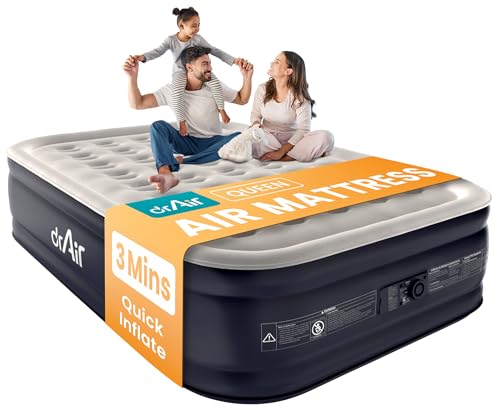 Dr. Air 18-Inch Queen Air Mattress
|
8.1/10 | Buy | |
 Luxchoice 9-Inch Twin Air Mattress
|
8.0/10 | Buy |
TOBTOS 6-Inch Double Camping Air Mattress
The TOBTOS Double Camping Mattress provides a generous 6-inch elevated loft for two adults, combining an integrated manual foot pump with durable 40D nylon TPU fabric that packs down under 4.1 pounds. It is an excellent fit for tent camping couples and car campers who want off-grid inflation convenience without hauling heavy electrical gear.
Pros
- Thick 6-inch profile delivers noticeable separation from uneven ground and gravel
- Integrated foot pump provides fully self-contained inflation without packing extra batteries or cords
- Compact packed size of 13 by 5.7 inches makes it far easier to transport than traditional heavy PVC air beds
- Integrated pillow and ergonomic curved outer baffles enhance sleep positioning
Cons
- Lacks a verified ASTM R-value rating, making supplemental foam pads advisable for cold-weather trips
- Single internal air chamber means movement can transfer between dual sleepers when shifting positions
- Foot pump requires consistent, rhythmic stepping on flat ground to reach full firmness
Dr. Air 18-Inch Queen Air Mattress
Equipped with an integrated pump, this 18-inch elevated air bed inflates in roughly three minutes to offer quick, reliable sleeping arrangements for overnight guests. Its internal honeycomb pillar system maintains firmness and minimizes motion transfer throughout the night.
Pros
- Fast three-minute inflation with integrated pump
- Substantial 18-inch elevated profile
- High 800-pound maximum weight capacity
- Internal coil structure reduces motion transfer
- Includes convenient travel storage bag
Cons
- Relatively heavy at 18 pounds for travel
- Requires electrical power to run the pump
Luxchoice 9-Inch Twin Air Mattress
Designed for tent camping and impromptu overnight guests, this twin air bed features an integrated cordless pump for rapid two-minute inflation away from electrical outlets. Its nine-inch profile combines internal coil support with a velvety flocked top to balance packability and comfort.
Pros
- Cordless rechargeable pump requires no external power source
- Fast two-minute inflation and deflation cycle
- Lightweight seven-pound design with included carry bag
- Internal coil beam construction provides steady support
Cons
- Low nine-inch height sits close to the ground
- Pump requires full pre-charging before outdoor trips
- PVC material naturally stretches during initial use
Complete Sizing and Layout Guide for 6-Person Camping Tents
Determining the ideal bedding configuration for a six-person tent begins with examining the difference between sleeping capacity and livable floor area. Tent manufacturers measure maximum capacity by calculating how many sleeping bags can lie side by side across the shelter floor without gap margins. When you replace thin sleeping pads with inflatable air beds, the math changes significantly. In reality, a standard six-person shelter comfortably holds two queen air beds at absolute maximum, three twin air beds, or one queen alongside a single twin. Choosing the right layout keeps gear dry, preserves walking pathways, and protects your mattress from rubbing against condensation-laden tent fabric.
The Camping Math Behind 6-Person Tent Ratings
The outdoor recreation industry calculates tent capacity based on minimal human dimensions rather than luxurious comfort. A typical adult sleeping bag measures approximately twenty to twenty-four inches wide by seventy-two inches long. When a manufacturer designs a six-person floor plan, they calculate space for six bodies arranged like sardines across the floor with zero luggage or clearance margins. This mathematical formula ensures compact tent packing for backcountry trekking, but it fails to account for recreational car camping expectations.
Recreational campers usually prioritize restful spinal alignment, pressure point relief, and clean personal space. An inflatable mattress provides essential separation from chilly soil, but its rigid footprint consumes significantly more volume than a basic pad. In practical camping scenarios, experienced outdoors enthusiasts divide the stated tent capacity by two to determine realistic occupancy with air beds. Applying this rule of thumb means a six-person tent comfortably shelters two to three adults sleeping on dedicated air mattresses while maintaining room for backpacks and footwear.
Standard Air Mattress Dimensions and Tent Floor Space
Evaluating your shelter starts with comparing the length and width of popular mattress sizes against standard tent floor dimensions. Most six-person tents feature floor dimensions ranging between ten feet by nine feet (ninety square feet) and ten feet by ten feet (one hundred square feet). In inches, a ten-by-nine tent offers one hundred twenty inches of width by one hundred eight inches of depth. Meanwhile, a standard twin air mattress measures roughly thirty-eight to thirty-nine inches wide by seventy-five inches long. A full or double mattress spans roughly fifty-four inches wide by seventy-five inches long, while a standard queen mattress measures sixty inches wide by eighty inches long.
Comparing these measurements directly against your tent floor demonstrates why multiple beds quickly crowd the perimeter. For example, placing two sixty-inch queen beds side by side consumes one hundred twenty full inches of width. That configuration leaves exactly zero inches of lateral space in a ten-foot tent, forcing both beds against the outer tent walls. Selecting specialized gear such as the tent camping air mattress options designed with narrower profiles or tapered corners can help you gain valuable perimeter margins.
Fitting Queen Size Air Beds in a 6-Person Tent
Many couples and families prefer queen size inflatable mattresses because they deliver home-like space and balanced support. In a standard ten-by-nine or ten-by-ten six-person tent, you can physically fit two queen mattresses if they are placed immediately side by side. However, this dual-queen arrangement covers nearly every square inch of usable floor surface. Campers must step directly onto their bedding to enter or exit the tent, and all clothing duffels must remain outside in a vehicle or vestibule.
A far more practical approach for most campers involves placing a single queen air bed on one side of the shelter. Products like the Dr. air Queen Air Mattress with Built-in Pump offer an expansive eighty-by-sixty-inch footprint that easily accommodates two adults while leaving ample space open on the opposite side. This single-queen configuration leaves roughly forty-eight to sixty inches of clear floor space along the opposite wall. That open area provides a dedicated staging ground for personal luggage, dog beds, changing clothes, or folding camp chairs during rainy afternoons.
Twin Air Mattress Configurations for Group Comfort
When friends or siblings share a shelter, arranging individual twin beds often proves superior to sharing large shared mattresses. A standard twin air bed requires approximately thirty-nine inches of width and seventy-five inches of length. Inside a ten-foot-wide six-person tent, three twin mattresses placed parallel to one another occupy roughly one hundred seventeen inches of width. This leaves just enough wiggle room to arrange three distinct sleeping zones without the beds overlapping or pressing violently against tent stakes.
Using three individual beds provides individual firmness customization so each sleeper can tailor internal air pressure to their preferred spinal support level. Models like the Luxchoice Air Mattress Twin with Built-in measure seventy-five by thirty-nine inches and fit neatly in parallel arrangements. Because each mattress only stretches seventy-five inches deep inside a one-hundred-eight-inch tent length, campers enjoy nearly thirty-three inches of open walkway space at the foot of their beds. This front-to-back buffer creates a convenient runway for entering through the main zippered door without stepping across anyone’s sleeping bag.
Combination Layouts: Pairing Queen, Double, and Twin Beds
Family camping dynamics frequently call for hybrid sleeping setups that accommodate parents and children together. A popular configuration in a six-person tent combines one queen air mattress with one single twin air mattress. A queen bed measuring sixty inches wide paired with a thirty-nine-inch twin consumes ninety-nine inches of total width. In a one-hundred-twenty-inch-wide shelter, this leaves a comfortable twenty-one-inch central walkway between the beds or a clean luggage corridor along the side wall.
Another versatile hybrid alternative utilizes double sleeping pads designed specifically for camping efficiency. Exploring double camping air mattress picks reveals options like the TOBTOS Double Sleeping Pad for Camping, which measures 78.7 by 51 inches. Pairing this fifty-one-inch double pad with a thirty-nine-inch twin mattress consumes only ninety inches of floor width. This compact pairing leaves thirty full inches of clearance inside a ten-foot tent, providing superior walking freedom while easily accommodating three family members.
How Tent Wall Slope and Mattress Profile Height Affect Space
Floor dimensions alone do not tell the complete story of tent fit because profile height interacts aggressively with wall geometry. Raised inflatable mattresses that stand fifteen to eighteen inches tall require significantly more central clearance than slim, low-profile pads. As tent walls slope upward from the perimeter stakes toward the center ridge, available horizontal width shrinks rapidly with every inch of elevation. A tall eighteen-inch mattress pushed against the edge will collide with angled fabric long before its base touches the floor seam.
For example, placing an eighteen-inch high-profile bed like the Dr. air Queen Air Mattress with Built-in Pump inside a steep dome tent forces you to pull the bed eight to twelve inches away from the perimeter. This necessary offset prevents the mattress edge from pressing against the rainfly, but it steals valuable floor space from the center of the tent. Conversely, slim sleeping pads like the six-inch TOBTOS Double Sleeping Pad for Camping or nine-inch options like the Luxchoice Air Mattress Twin with Built-in sit much lower to the ground. Their low profiles allow them to slide closer to angled perimeter walls without distorting the tent body.
Cabin Tents Versus Dome Tents for Inflatable Bed Clearance
The structural silhouette of your six-person tent plays a pivotal role in how many air beds you can successfully install. Traditional dome tents feature curving fiberglass poles that create an arched roof structure with pronounced wall slope. While dome tents shed wind and precipitation effectively, their inward-sloping perimeter walls drastically limit usable headroom and edge space. In a dome shelter, fitting two bulky mattresses often forces bedding into tight contact with angled mesh panels.
In contrast, cabin-style six-person tents utilize rigid steel or aluminum upright poles that create near-vertical sidewalls and high ceiling peaks. These vertical walls allow campers to push high-profile air beds directly against the outer edges without touching sloped rainflies. If you plan to sleep four campers on two large queen mattresses or multiple elevated twin beds, a cabin tent provides substantially more practical volume than a dome tent of identical square footage. The squared corners and upright walls transform floor area into functional living space from edge to edge.
Gear Storage and Walking Paths: Preserving Livable Tent Space
A common pitfall among novice campers is maximizing mattress floor coverage while forgetting about essential gear storage. Outdoor trips involve duffel bags, extra blankets, footwear, flashlights, and coolers that require dry indoor space. If you fill a six-person tent with two queen mattresses, your equipment must sit directly on top of your sleeping blankets. This clutter introduces mud, reduces sleep comfort, and increases the risk of puncturing PVC air chambers with zipper teeth or stray pocket contents.
Maintaining a dedicated walking corridor between your tent entrance and sleeping stations is equally critical for safety and comfort. Midnight bathroom trips become hazardous when campers must crawl blindly across crowded air chambers in pitch darkness. Designing your layout to leave at least eighteen to twenty-four inches of unobstructed pathway from the door zipper protects bed valves and preserves tent floor integrity. When arranging multiple beds, orient them so that headboards rest against rear walls and clear aisles point toward the main doorway.
Preventing Moisture and Condensation When Mattresses Touch Tent Walls
Condensation management is one of the most critical reasons to avoid jamming too many air mattresses into a six-person shelter. During cool evenings, warm human breath elevates humidity levels inside the sealed tent cabin. When this moist air meets cold exterior fabrics, water droplets condense along the interior coated walls and rainfly. If an inflated PVC mattress or sleeping bag presses tightly against the tent fabric, capillary action wicks moisture directly into your sheets.
Waking up against a damp tent wall can ruin an otherwise pleasant wilderness outing and saturate insulating sleeping bag fills. Maintaining a minimum gap of four to six inches between your mattress edge and outer tent walls allows proper ventilation to circulate along perimeter vents. Selecting durable bedding constructed with waterproof coatings, such as 40D nylon and TPU on the TOBTOS Double Sleeping Pad for Camping, helps repel ground dampness. However, preventing physical contact with the rainfly remains your primary defense against moisture infiltration.
Ground Insulation, Cold Air Convection, and Thermal Comfort
Sleeping on an air mattress outdoors presents distinct thermodynamic challenges that differ from indoor bedroom sleep. An air mattress is essentially a giant chamber filled with ambient air that quickly matches the cold temperature of the outdoor soil. Through conductive and convective heat transfer, the chilly ground pulls warmth from the mattress core, which subsequently leaches body heat from your spine. Without proper thermal insulation beneath your body, even a firm air mattress can feel uncomfortably frigid overnight.
To preserve spinal warmth and encourage deep muscle relaxation, campers should place protective insulating barriers under and over their beds. Laying a heavy-duty tarp, moving blanket, or closed-cell foam pad beneath the air mattress blocks cold soil conductivity and shields vinyl from sharp twigs. Adding a quilted fitted sheet or wool blanket on top of flocked surfaces prevents cool internal air from chilling your back. Proper insulation preserves your internal core warmth, allowing the internal air coils or honeycomb pillars to provide stable ergonomic support without drawing away your vital heat.
Managing Inflation Power: Corded, Rechargeable, and Foot Pumps
How you power your mattress inflation hardware dictates campsite logistics and tent placement. Many raised queen beds feature integrated one-hundred-ten-volt electric pumps designed for household wall outlets or campsite electrical hookups. If your six-person tent features an integrated zippered electrical cord access port (E-port), running an outdoor-rated extension cord from a powered campsite pedestal makes inflating large mattresses effortless. However, camping at primitive or dispersed sites requires alternative power methods to avoid manual exhaustion.
Cordless and manual systems eliminate dependency on campsite power grids while maintaining rapid setup times. The Luxchoice Air Mattress Twin with Built-in utilizes a cordless rechargeable pump that inflates beds in roughly two minutes without tangled cables. For ultimate backcountry freedom, the TOBTOS Double Sleeping Pad for Camping incorporates a built-in foot pump, allowing full inflation in two to three minutes using rhythmic pedal action. Matching your pump type to your camping destination ensures you never end up stranded with deflated bedding deep in the wilderness.
Practical Checklist Before Setting Up Sleep Systems in Camp
Before unrolling your inflatable beds inside the tent, a few proactive preparation steps will protect your investment and optimize rest. First, inspect the ground surface thoroughly before pitching your tent, removing sharp pinecones, small rocks, and dried brambles that could puncture PVC floors. Always sweep interior tent seams and place a protective floor mat inside high-traffic zones to prevent dirt abrasion. Fully inflate your air mattresses at home twenty-four hours before your trip to allow vinyl materials to stretch naturally and confirm airtight valve seals.
Once arrived at camp, inflate your mattresses in daylight hours so you can fine-tune internal firmness and verify door clearances before nightfall. Keep repair patches and vinyl adhesive handy inside your tent pocket for immediate emergency repairs should a valve leak occur. By balancing your sleeper count against actual tent floor geometry, leaving perimeter ventilation buffers, and selecting the right mattress heights, you ensure a comfortable outdoor retreat that keeps everyone refreshed throughout your camping adventure.
About the author
Logan Foley is a Certified Sleep Science Coach and experienced mattress and sleep-product researcher. She has personally evaluated hundreds of mattress models, with expertise in comparing construction, comfort, support, materials and sleeper needs to turn complex product differences into practical buying guidance.