
Can You Take an Air Mattress in a Carry On? Rules and Packing Guide for 2026
Can you take an air mattress in a carry on during flights? Learn airline size rules, pump guidelines, and packing advice for October 2026.
 By Jackson Lindeke
Updated October 6, 2026
By Jackson Lindeke
Updated October 6, 2026

Traveling to visit family or heading out on an extended trip often leaves sleepers dreading uncomfortable hotel cots or stiff guest room floors. Packing your own portable sleep system ensures you maintain proper spinal alignment and cushioning wherever you land, which leads many travelers to ask: can you take an air mattress in a carry on? The short answer is yes, because aviation security agencies allow inflatable beds in your cabin luggage as long as the deflated package fits standard carry-on dimensions and meets airline weight restrictions. Whether you are transporting a lightweight pad or a plush air mattress for guests, understanding airline baggage allowances helps avoid surprise fees at the departure gate.
Carry-on luggage dimensions generally max out at twenty-two inches by fourteen inches by nine inches, meaning bulkier raised beds require careful folding to leave room for clothing and personal essentials. While compact designs engineered for camping air mattresses slip effortlessly into an overhead roller bag, double-height queen beds can weigh up to sixteen pounds and dominate your allotted packing volume. Checking your airline pump policies, electrical specifications, and total cabin weight limits before heading to the airport guarantees a smooth security screening and restorative rest at your destination.
| Award | Product | AMG Score About AMG ScoreThe AMG Score is our own rating from 0 to 10, based on performance, design and build, ease of use, and value. It reflects independent research and is never influenced by manufacturers, retailers, or affiliate commissions. Learn more › | |
|---|---|---|---|
| Best Overall |
DIMAR GARDEN 9-Inch Single Air Mattress with Hand
|
9.1/10 | Buy |
| Best Budget |
 Intex Dura-Beam Standard Single-High Camping Air
|
8.8/10 | Buy |
| Best Value |
 Sweetcrispy 22-Inch Queen Air Mattress
|
8.8/10 | Buy |
 Intex Dura-Beam Standard Queen Camping Air
|
8.3/10 | Buy | |
 Intex Dura-Beam 22-Inch Queen High-Rise Camping
|
8.3/10 | Buy | |
| Best Premium |
 Dr. Air 18-Inch Queen Air Mattress
|
8.1/10 | Buy |
 King Koil 20-Inch Queen Air Mattress with Built-In
|
8.1/10 | Buy | |
 MOXILS Ultralight Inflatable Sleeping Pad
|
8.0/10 | Buy | |
 Intex Dura-Beam Standard Downy Twin Camping Air
|
7.8/10 | Buy | |
 Dr. Air 18-Inch Queen Air Mattress
|
7.8/10 | Buy |
DIMAR GARDEN 9-Inch Single Air Mattress with Hand
The DIMAR GARDEN Single Size Air Mattress is a portable 9-inch inflatable bed crafted with puncture-resistant PVC and a soft flocked top. Featuring adjustable air firmness and an included manual pump, it is an affordable temporary sleep solution for solo campers and guest rooms supporting up to 220 pounds.
Pros
- Includes a dedicated manual hand pump for easy off-grid inflation anywhere
- Waterproof PVC base and flocked top provide durable moisture resistance and surface comfort
- Elevated 9-inch height keeps campers and guests well off the floor
- Compact single footprint fits easily into narrow tents, campers, or small spare rooms
Cons
- Narrow 29-inch width provides less rolling room than a standard 38-inch twin bed
- Maximum weight capacity of 220 pounds does not support heavyweight sleepers or multiple users
- Manual pumping requires physical effort compared to built-in electric pumps
Intex Dura-Beam Standard Single-High Camping Air
The Intex Dura-Beam Standard Single-High Twin Air Mattress delivers dependable 10-inch elevated comfort and lightweight 3-pound packability for solo tent campers, scouts, and car campers. Built with Fiber-Tech polyester beams and a wide 2-in-1 valve, it offers solid non-sagging support at an accessible price point, provided you bring your own external camp pump.
Pros
- Fiber-Tech internal polyester fiber structure holds shape better than traditional hollow vinyl beams
- Lightweight 3-pound trail and trunk weight offers hassle-free transport to remote campsites
- Low 10-inch profile fits comfortably inside low-clearance backpacking and car camping dome tents
- Extra-wide 2-in-1 valve speeds up both inflation and complete morning deflation
- Soft flocked top surface keeps sleeping bags and sheets from sliding off during the night
Cons
- Requires a separate external air pump since no inflator or power adapter is included in the box
- Natural initial material stretching softens the mattress over the first 2-3 nights, requiring periodic top-offs
- Lacks internal thermal insulation or an ASTM R-value rating, requiring an insulated closed-cell foam pad for cold ground protection
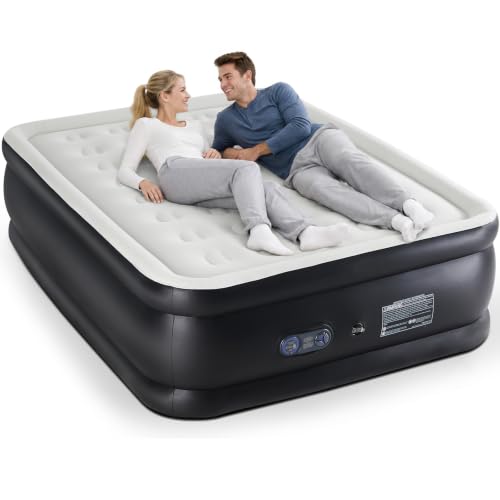
Sweetcrispy 22-Inch Queen Air Mattress
With an elevated 22-inch double-height design, this Sweetcrispy mattress inflates in four minutes using an integrated 110V electric pump. Its honeycomb structure supports up to 660 pounds, making it a supportive choice for home hosting or powered campsites.
Pros
- High 660-pound weight support
- Built-in electric pump allows fast setup
- Elevated 22-inch height provides bed-like feel
- Non-slip bottom reduces floor noise
- Comfortable moisture-wicking flocked top
Cons
- Requires a 110V power outlet to operate
- Weighs 17.4 pounds, limiting manual portability
- Larger footprint requires significant tent space
Intex Dura-Beam Standard Queen Camping Air
The Intex Dura-Beam Standard Queen Air Mattress provides a low-profile 10-inch sleeping platform supported by internal Fiber-Tech polyester beams and a 600-pound weight capacity. It is an affordable, lightweight sleep option for weekend car campers and tent sleepers who already own a compatible campsite pump.
Pros
- Fiber-Tech polyester fiber construction helps maintain firmness and reduce sagging compared to standard vinyl beams
- Low-profile 10-inch height fits comfortably inside compact dome tents without touching sloped ceiling fabrics
- Generous 600-pound weight capacity and 80 by 60 inch queen footprint support dual campers with ease
- Lightweight 6.5-pound build packs down small for car trunk packing and weekend campground travel
Cons
- Air pump is sold separately, requiring you to bring your own 12V vehicle inflator, battery pump, or manual pump
- Material naturally stretches during the initial 2-3 nights of use, requiring top-off air to maintain firmness
- Lacks internal thermal insulation or a reviewed R-value, making a foam pad necessary over cold ground
Intex Dura-Beam 22-Inch Queen High-Rise Camping
The Intex Dura-Beam 22-Inch Queen Air Mattress provides standing-height comfort and dependable Fiber-Tech internal support for electric-hookup campsites and cabin trips. With a built-in 110-120V electric pump and a 600-pound weight capacity, it is a great choice for car campers with access to AC power.
Pros
- High 22-inch elevation makes getting in and out of bed as easy as a traditional home mattress.
- Built-in 110-120V electric pump delivers quick, hands-free inflation and deflation in under five minutes.
- Dura-Beam Fiber-Tech construction provides reliable horizontal body support with a 600-pound limit.
- Velvety flocked finish adds surface comfort and helps reduce sleeping bag sliding.
Cons
- Integrated electric pump requires a standard 110-120V household outlet, campground electric pedestal, or portable AC power station.
- Tall 22-inch profile can press against angled walls in low-profile dome tents, requiring a standing-height cabin tent.
- Initial material stretching during the first few nights requires air top-offs before the vinyl fully settles.
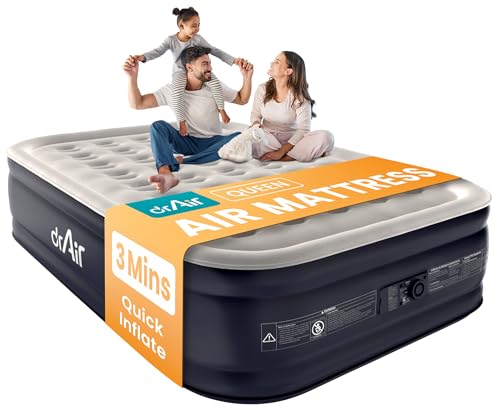
Dr. Air 18-Inch Queen Air Mattress
Equipped with an integrated pump, this 18-inch elevated air bed inflates in roughly three minutes to offer quick, reliable sleeping arrangements for overnight guests. Its internal honeycomb pillar system maintains firmness and minimizes motion transfer throughout the night.
Pros
- Fast three-minute inflation with integrated pump
- Substantial 18-inch elevated profile
- High 800-pound maximum weight capacity
- Internal coil structure reduces motion transfer
- Includes convenient travel storage bag
Cons
- Relatively heavy at 18 pounds for travel
- Requires electrical power to run the pump
King Koil 20-Inch Queen Air Mattress with Built-In
The King Koil 20-inch Queen Air Mattress delivers elevated, bed-like comfort with internal coil-beam support and a fast 2-minute 120V AC inflation system. Ideal for cabin campers, glampers, and powered campsite setups, it provides a stable 650-pound weight capacity for campers who prioritize easy bed entry.
Pros
- Elevated 20-inch height makes standing up and lying down much easier than low-profile floor pads
- Patented 120V / 210W AC pump inflates the mattress in just 2 minutes at powered campsites
- Internal coil-beam construction offers solid stability and supports up to 650 lbs for couples
- Plush flocked top surface improves comfort and helps grip sheets or sleeping bags
Cons
- Requires a standard 120V AC household outlet, campground electrical hookup, or compatible power inverter to run the built-in pump
- Tall 20-inch double-high profile can press against sloping walls in smaller low-profile dome tents
- Uninsulated internal air chambers offer no rated R-value, requiring an insulating topper for cold-weather camping
MOXILS Ultralight Inflatable Sleeping Pad
Designed for streamlined campsite setup, this packable sleeping pad integrates a foot-operated pump to eliminate mouth inflation and separate gear. Side snaps make it easy to connect two mats into a double bed for shared tent setups.
Pros
- Integrated foot pump eliminates mouth inflation
- Weighs less than two pounds for backpacking
- Thick 3.5-inch loft provides generous ground clearance
- Side buttons quickly connect two pads together
- Includes six repair patches in the package
Cons
- 25-inch width may feel narrow for active sleepers
- Manual foot pumping requires physical effort to inflate
- Air chamber design remains susceptible to sharp terrain punctures
Intex Dura-Beam Standard Downy Twin Camping Air
The Intex Dura-Beam Standard Downy Twin is a lightweight 10-inch camping air mattress built with internal Fiber-Tech polyester fibers and a soft flocked top. It provides an affordable, low-profile sleeping solution for solo car campers, tent setups, and weekend cabin guests who bring their own air pump.
Pros
- Internal Fiber-Tech polyester beam structure provides firmer structural support than basic vinyl baffles
- Low 10-inch single-high profile fits cleanly beneath sloped tent walls without brushing condensation
- Velvety flocked top surface keeps bedding secure and feels pleasant against bare skin
- Extra-wide 2-in-1 valve speeds up deflation when packing camp before bad weather hits
- Lightweight 5.3-pound packed weight makes it easy to haul from the vehicle to the campsite
Cons
- Air pump is sold separately, so campers must supply their own manual, 12V, or battery inflator
- Initial vinyl stretching requires regular air top-offs over the first two to three nights
- Hollow uninsulated air chambers lack a verified R-value and feel chilly on freezing ground without a foam pad
Dr. Air 18-Inch Queen Air Mattress
Built with an 18-inch raised profile and internal honeycomb coils, this Queen air bed offers supportive sleeping height for overnight guests and car campers alike. Its integrated pump inflates the bed in roughly three minutes, while puncture-resistant PVC construction helps maintain steady overnight support.
Pros
- Rapid three-minute inflation with integrated pump
- Tall 18-inch height allows easy entry and exit
- Honeycomb coil system helps minimize motion transfer
- Sturdy 800-pound maximum weight capacity
Cons
- Weighs 18 pounds, making it heavier to transport
- Integrated pump requires an electrical outlet during camping
- Large Queen footprint requires ample floor clearance
Navigating Airline Regulations and Packing Logistics for Inflatable Beds
Airline passengers frequently struggle to secure a comfortable sleeping surface when staying with relatives, attending multi-day conventions, or renting temporary accommodations. Bringing your own inflatable mattress guarantees familiar lumbar support, yet coordinating with airline baggage rules requires strategic planning before arriving at the terminal. Understanding how transportation security agencies view inflatable vinyl furniture allows travelers to navigate airport checkpoints smoothly while protecting their personal luggage allowances.
TSA and Aviation Security Guidelines for Inflatable Mattresses
The Transportation Security Administration treats deflated air mattresses as standard personal property, permitting them in both carry-on and checked baggage without special declarations. Standard vinyl and polyester sleep surfaces contain no hazardous chemicals, pressurized gases, or restricted materials that trigger security alarms. Transportation officers will simply view the folded mattress on the standard X-ray monitor alongside your clothing, shoes, and electronic accessories.
Because an airbed consists of dense layers of folded polyvinyl chloride, security scanners may occasionally struggle to penetrate the thickest folds of material. If an X-ray technician cannot clearly see through the bundled fabric, security personnel will pull your carry-on bag aside for a brief manual inspection. Keeping the mattress placed near the top of your rolling suitcase ensures quick access if an agent asks to inspect the valves, internal coils, or flocked fabric.
Built-In Electric Pumps Versus External and Manual Inflation Tools
The primary factor that complicates bringing an inflatable bed through an airport checkpoint involves the inflation mechanism attached to the mattress. Many raised airbeds, such as elevated queen models, feature integrated electric pumps that run on standard household alternating current. Corded electric motors contain standard copper windings and a power plug, which pass through airport security without violating aviation rules.
Travelers must exercise caution when packing airbeds equipped with rechargeable lithium-ion battery packs or portable cordless pumps. Federal aviation regulations strictly prohibit loose, uninstalled lithium-ion batteries in checked baggage due to thermal runaway fire hazards, requiring passengers to keep them in carry-on bags. If your travel mattress relies on a standalone rechargeable battery pump, ensure the battery capacity remains under one hundred watt-hours to comply with standard domestic and international airline safety caps.
Manual inflation options eliminate pump-related screening questions entirely and significantly reduce packing bulk. Compact camping pads and single-high mattresses often use integrated foot-press chambers, bellow valves, or small hand pumps that require zero electrical power. Relying on manual or foot-operated systems prevents voltage mismatches when traveling abroad, where overseas wall outlets operate on different currents than North American household circuits.
Carry-On Luggage Dimensions and Overhead Bin Constraints
Most major domestic carriers enforce a standard carry-on size restriction of twenty-two inches long, fourteen inches wide, and nine inches deep. A typical rolling carry-on offers roughly forty to forty-five liters of internal storage capacity. Placing a fully deflated, double-height queen airbed into that space can easily consume more than half of your total packing volume.
Low-profile single-high mattresses, by contrast, compress into bundles no larger than a standard rolled bath towel. Single-high twin beds provide a ten-inch sleeping clearance off the ground while occupying less than fifteen percent of a carry-on suitcase interior. Choosing a streamlined bed height leaves adequate space for garments, toiletries, travel pillows, and necessary sleep accessories without requiring an extra personal item bag.
Overhead storage bins also feature rigid dimensional frames, meaning bulging or overstuffed luggage may fail to fit inside the aircraft cabin compartments. Gate attendants frequently force passengers with over-expanded bags to gate-check their luggage on crowded regional flights. Packing your mattress inside a structured travel bag with integrated cinch straps prevents the vinyl material from expanding during your transit through the terminal.
Weight Allowances and Cabin Luggage Restrictions
While many major domestic airlines in North America do not impose strict weight limits on carry-on bags, budget carriers and international airlines enforce rigid caps. Typical international carry-on weight restrictions range from fifteen to twenty-two pounds in total cabin baggage weight. A heavy luxury queen airbed with internal structural coils and an integrated motor can weigh upwards of sixteen pounds on its own.
Exceeding the carry-on baggage allowance at the departure gate results in mandatory checked bag fees and potential travel delays. If an airline agent places your rolling suitcase on a scale and discovers excessive weight, you will be forced to check the bag into the aircraft cargo hold. Checking the published baggage weight guidelines for every airline on your itinerary protects you from unexpected expenses before you arrive at the gate.
Comparing Travel-Friendly Mattress Profiles and Construction Types
Selecting the right mattress profile balances nighttime ergonomic support against daytime travel convenience. Ultralight sleeping pads weighing under two pounds represent the easiest option for strict carry-on travel, slipping into backpack side sleeves or briefcase compartments. These lightweight designs use horizontal or honeycomb air chambers that insulate the body from cold floor drafts while offering basic joint cushioning for back and stomach sleepers.
Single-high vinyl mattresses measuring ten inches in height deliver a substantial upgrade in comfort without adding excessive bulk to your luggage. These mattresses utilize high-strength internal polyester fibers or coil-beam chambers that prevent deep center sagging and maintain neutral spinal alignment. Solo travelers and vacationers often find that single-high designs offer the ideal balance between luggage portability and nightly pressure relief across the hips and shoulders.
Couples traveling together often consider packing full-size or double-height models to accommodate two sleepers comfortably. While spacious air mattresses for two adults provide elevated sleeping heights and reduced motion transfer, their substantial packed dimensions make fitting them into a single carry-on difficult. Splitting the sleep system across two carry-on suitcases, with one traveler carrying the mattress and the other carrying bedding and pump gear, solves the packing space dilemma efficiently.
Step-by-Step Packing Guide to Compress Your Airbed for Travel
Proper folding technique determines whether an inflatable mattress fits into a carry-on suitcase or becomes an unmanageable bundle. Begin by opening all air valves fully and laying the deflated mattress completely flat on a smooth, clean floor. Kneel on the far end of the bed and gently crawl forward toward the valve to expel residual pockets of trapped air from the internal chambers.
Once the mattress lies flat, fold the outer edges inward in parallel thirds so that the width matches the internal dimensions of your suitcase. Fold the mattress accordion-style or roll it tightly starting from the foot of the bed toward the open valve opening. Keeping the valve open during rolling forces every remaining cubic inch of air out of the internal Fiber-Tech or coil chambers.
Secure the tightly rolled mattress with elastic straps, hook-and-loop ties, or a nylon compression stuff sack before placing it into your luggage. Never use sharp tools, metal clips, or abrasive cordage that could puncture the delicate vinyl exterior during transit. Placing the wrapped mattress into a dedicated dust bag shields the flocked top fabric from dirt, lint, and rough suitcase zippers.
Managing Cabin Pressure Changes and Transit Protection
Commercial aircraft maintain cabin altitudes equivalent to six thousand to eight thousand feet above sea level, causing slight changes in air pressure. If a traveler leaves trapped air sealed inside a closed mattress valve, the ambient pressure drop can cause the residual air to expand slightly during flight. Ensuring your mattress valves remain unlocked or completely evacuated prevents unnecessary stress on internal structural seams while cruising at high altitudes.
Luggage undergoes continuous shifting, vibration, and friction while stored in overhead bins or shoved beneath passenger seats. Sharp objects inside your suitcase, such as toiletry scissors, charging cables, and shoe buckles, can press against folded vinyl seams and create tiny pinholes. Packing dedicated repair tape for air mattresses inside your travel kit ensures you can quickly patch accidental punctures and restore airtight integrity if unexpected damage occurs.
Setting Up and Restoring Ergonomic Support at Your Destination
Arriving at your destination after a long flight requires careful handling during the initial inflation process. Polyvinyl chloride fabric stiffens in cold environments, particularly if your luggage spent time on a chilly airport apron or in cold transport shuttles. Allow the folded mattress to sit in the heated room for twenty to thirty minutes before unfolding it to prevent micro-cracks along stiff crease lines.
Once the material reaches room temperature, connect your inflation pump and fill the chambers until the sleeping surface feels firm and supportive. New airbeds and recently compressed materials undergo natural synthetic stretching during their first few nights of continuous inflation. Sleeper weight naturally expands the new polymer bonds, which can cause a slight drop in surface pressure that sleepers sometimes mistake for an air leak.
Adjusting the internal pressure allows you to customize the mattress to your specific sleeping position and body weight. Side sleepers benefit from slightly softer inflation that lets shoulders and hips sink into the plush flocked surface, relieving joint pressure and keeping the spine level. Back and stomach sleepers require a firmer inflation profile to prevent pelvic sinkage, maintain neutral lumbar support, and avoid morning back stiffness.
Long-Term Care, Storage, and Return Travel Preparation
Maintaining your travel air mattress across multiple trips requires attentive care each time you pack up to return home. Always inspect the floor beneath your mattress before deflating, clearing away stray grit, carpet staples, or hard debris that could embed into the bottom vinyl layer. Wiping down the flocked surface with a slightly damp cloth removes accumulated skin oils, dust mites, and sweat before rolling the bed for the journey back.
Allow the mattress to dry completely before packing it into your carry-on bag to prevent moisture from causing mildew or unpleasant odors during travel. Rolling a damp mattress tightly into an unventilated suitcase can degrade synthetic coatings and weaken adhesive seam bonds over time. Taking a few extra minutes to air out the fabric guarantees that your portable bed remains fresh, sanitary, and ready for future adventures.
Practical Takeaways for Flying with Inflatable Beds
Flying with an inflatable bed provides an affordable and reliable way to ensure sound sleep wherever your travels lead. By selecting a lightweight single-high mattress or compact sleeping pad, travelers can comfortably meet strict airline carry-on size rules without sacrificing vital clothing space. Verifying pump configurations, handling compression methodically, and packing necessary patch kits ensures that you arrive at your destination fully prepared for restorative, pain-free sleep.
Taking the time to measure your carry-on luggage and calculate total bag weight before heading to the airport removes travel friction and eliminates gate-check surprises. When you match your sleep surface to your specific ergonomic needs, you protect your back from uncomfortable temporary bedding throughout your trip. With thoughtful packing and careful maintenance, an inflatable travel bed transforms any guest room floor or rental space into a welcoming, supportive haven.
About the author
Jackson Lindeke is a Certified Sleep Science Coach and product expert specializing in mattresses, bedding and sleep products. He has years of experience developing evaluation methods and translating product-testing data into practical recommendations that help consumers choose products suited to their individual sleep needs.