
How Much Does a Queen Size Air Mattress Weigh: Practical Guide for 2026
Learn how much does a queen size air mattress weigh for guest rooms and travel in November 2026, comparing packed pounds and profile heights.
 By Logan Foley
Updated October 13, 2026

Unpacking a temporary bed for overnight visitors or loading gear into a car trunk often raises immediate questions about lifting effort and pack portability. While standard queen mattresses require multiple people to transport, understanding how much does a queen size air mattress weigh helps hosts and travelers plan their storage and transit needs realistically. A deflated queen inflatable bed generally tips the scales between 9 and 22 pounds depending on structural height and pump integration. When comparing sleeping pads and inflatable beds, physical heft quickly becomes a deciding factor for anyone managing limited closet space or vehicle cargo limits.
The total carry weight of an inflatable bed reflects its internal engineering rather than pure bulk. Compact 10-inch single-high models prioritize lightweight vinyl and streamlined chambers, making them easy to carry in one hand. Conversely, raised 18-inch to 20-inch double-high guest beds integrate heavier electric motor housings, reinforced internal beams, and thicker puncture-resistant sidewalls. Knowing these exact physical characteristics ensures you select a bed that balances back-friendly handling with reliable sleep support.
| Award | Product | AMG Score About AMG ScoreThe AMG Score is our own rating from 0 to 10, based on performance, design and build, ease of use, and value. It reflects independent research and is never influenced by manufacturers, retailers, or affiliate commissions. Learn more › | |
|---|---|---|---|
| Best Overall |
Intex Dura-Beam Standard Pillow Rest Queen Air
|
8.9/10 | Buy |
| Best Value |
 VOSSER 18-Inch Queen Camping Air Mattress |
8.8/10 | Buy |
| Best Budget |
 Dr. Air 18-Inch Queen Air Mattress |
8.1/10 | Buy |
| Best Premium |
 King Koil 20-Inch Queen Air Mattress with Built-In |
8.1/10 | Buy |
Intex Dura-Beam Standard Pillow Rest Queen Air
The Intex Dura-Beam Standard Pillow Rest Queen Air Mattress delivers low-profile 10-inch tent clearance, a 600-pound weight capacity, and Fiber-Tech internal stability. It is an affordable option for car campers and cabin guests with access to 110-120V power.
Pros
- Quick inflation and deflation in about 2.25 minutes via the integrated 110-120V AC electric pump.
- Fiber-Tech polyester fiber beams and bottom perimeter ring provide solid support up to 600 pounds.
- Low-profile 10-inch height fits easily under angled tent walls in standard dome tents.
- Velvety flocked sleeping surface feels soft to the touch and helps prevent sleeping bags from sliding.
Cons
- Requires a 110-120V AC outlet, requiring campers to bring an AC generator, vehicle inverter, or portable power station for tent use.
- Contains uninsulated air chambers without an official R-value rating, making an external foam sleeping pad necessary in colder weather.
- Natural material stretching during the first 2-3 nights will soften initial firmness and require minor air top-offs.
VOSSER 18-Inch Queen Camping Air Mattress
Featuring an elevated 18-inch profile and vertical beam construction supporting up to 800 pounds, the VOSSER Queen Air Mattress delivers real-bed comfort for cabin setups and powered campsites. Its integrated 110-120V pump inflates the bed in under 3 minutes, making it an excellent choice for family tent campers with access to electricity.
Pros
- Generous 800-pound maximum weight capacity easily supports camping couples without severe center sag.
- Elevated 18-inch double-high design keeps sleepers well off cold tent floors and makes getting in and out effortless.
- Fast inflation in under 3 minutes via the integrated 110-120V electric pump.
- Soft flocked top helps keep fitted sheets in place and reduces vinyl squeaking during night movement.
Cons
- Requires a standard 110-120V AC wall outlet or portable power station inverter, limiting direct off-grid primitive camping use.
- Hollow uninsulated air core lacks a reviewed R-value and may require an external foam pad on chilly autumn nights.
- Tall 18-inch profile may crowd sloped walls in low-clearance backpacking or small dome tents.
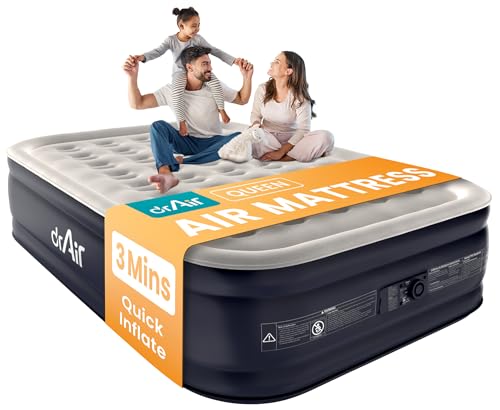
Dr. Air 18-Inch Queen Air Mattress
Equipped with an integrated pump, this 18-inch elevated air bed inflates in roughly three minutes to offer quick, reliable sleeping arrangements for overnight guests. Its internal honeycomb pillar system maintains firmness and minimizes motion transfer throughout the night.
Pros
- Fast three-minute inflation with integrated pump
- Substantial 18-inch elevated profile
- High 800-pound maximum weight capacity
- Internal coil structure reduces motion transfer
- Includes convenient travel storage bag
Cons
- Relatively heavy at 18 pounds for travel
- Requires electrical power to run the pump
King Koil 20-Inch Queen Air Mattress with Built-In
The King Koil 20-inch Queen Air Mattress delivers elevated, bed-like comfort with internal coil-beam support and a fast 2-minute 120V AC inflation system. Ideal for cabin campers, glampers, and powered campsite setups, it provides a stable 650-pound weight capacity for campers who prioritize easy bed entry.
Pros
- Elevated 20-inch height makes standing up and lying down much easier than low-profile floor pads
- Patented 120V / 210W AC pump inflates the mattress in just 2 minutes at powered campsites
- Internal coil-beam construction offers solid stability and supports up to 650 lbs for couples
- Plush flocked top surface improves comfort and helps grip sheets or sleeping bags
Cons
- Requires a standard 120V AC household outlet, campground electrical hookup, or compatible power inverter to run the built-in pump
- Tall 20-inch double-high profile can press against sloping walls in smaller low-profile dome tents
- Uninsulated internal air chambers offer no rated R-value, requiring an insulating topper for cold-weather camping
Understanding Queen Air Mattress Weight and Portability
A standard queen size air mattress typically weighs between 9 and 22 pounds when completely deflated and packed into its storage sack. The exact number on the scale depends almost entirely on the bed profile height, the presence of an integrated electric pump, and the density of the PVC materials used in construction. Lightweight single-high models designed for travel lean toward the lower end of that spectrum, often weighing under 12 pounds. Heavy-duty double-high beds built for home guest rooms sit firmly near the top end, frequently weighing between 16 and 22 pounds. Knowing this range helps you anticipate whether moving the bed requires casual one-handed transport or two-handed lifting.
Average Weight Breakdown by Mattress Profile Height
Low-profile single-high queen mattresses usually measure between 8 and 10 inches in inflated height and weigh between 8 and 12 pounds. These compact beds utilize single-chamber cavities with streamlined internal baffling, minimizing the total surface area of synthetic vinyl required to maintain structural shape. A model like the INTEX 64149ED Dura-Beam Standard Pillow Rest Air Mattress provides a classic example of this low-profile engineering at a 10-inch height. Because there is less vinyl material stretching from the floor to the top sleeping deck, the overall packed mass stays modest and manageable.
Mid-height and double-high queen air beds typically stand between 16 and 18 inches tall and register between 14 and 19 pounds. These elevated dimensions require nearly twice as much vinyl material along the perimeter sidewalls to suspend sleepers comfortably above floor level. The VOSSER Air Mattress Queen with Built-in Pump exemplifies this category, with the manufacturer listing an exact product weight of 18 pounds for an 18-inch raised build. That extra mass provides substantial stability and makes climbing into bed feel much closer to using a traditional box-spring mattress.
Premium high-profile queen mattresses that reach 20 to 22 inches in height represent the heaviest standard blow-up beds on the market, commonly weighing 18 to 23 pounds. Mattresses such as the King Koil Air Mattress Queen with Built-in Pump feature expansive 20-inch raised walls that demand dense internal coil-beam construction to prevent edge roll-off. The additional internal polymer columns and extended perimeter barriers add noticeable physical heft to the carrying bag. While these beds require more effort to lift from a closet shelf, the elevated stance offers unmatched convenience for older guests who struggle to stand up from floor level.
How Built-In Electric Pumps Impact Total Carry Weight
The primary hardware component contributing to the total packed weight of a modern queen air bed is the integrated 110-120V AC electric pump. A permanent built-in electric motor adds approximately 2 to 4 pounds of concentrated hardware to one corner of the mattress. This weight accounts for copper motor windings, internal impeller blades, electrical wiring, a rotary control dial, and the rigid plastic housing that seals the pump airtight into the vinyl wall.
Models with manual Boston valves or external pump ports avoid this integrated hardware penalty, allowing their deflated weight to remain several pounds lighter. However, external pumps require travelers to pack separate battery packs, hand pumps, or charging cords that ultimately take up comparable gear space. The convenience of turning a single integrated dial to achieve full inflation in roughly two to three minutes usually justifies carrying those extra three pounds of built-in motor components.
Some specialized beds also include integrated cord storage compartments molded directly into the pump frame to keep the electrical line neatly stowed. This rigid housing protects the electrical cord from tangling or snagging against rough floors during transit. While these durable molded plastic enclosures add several ounces, they eliminate the risk of misplacing loose charging adapters or damaging power connections.
Material Thickness and Internal Beam Architecture
The gauge and formulation of polyvinyl chloride (PVC) used across the mattress body directly influence overall scale weight. Standard entry-level air beds use thinner single-ply vinyl sheets to keep shipping costs and manufacturing weight low. In contrast, heavy-duty designs, such as the Dr. air Queen Air Mattress with Built-in Pump, incorporate 34 percent thicker puncture-resistant materials and reinforced seams to withstand heavy daily use. That increased material thickness naturally translates into several additional pounds of dense synthetic resin across the full 60 by 80-inch queen footprint.
Internal structural architecture also plays a significant role in determining how much the bed weighs. Traditional air mattresses relied on simple horizontal or vertical vinyl chambers that required minimal material but were prone to stretching and sagging. Modern performance air beds incorporate thousands of high-strength polyester fiber threads or complex vertical coil beams to maintain spinal alignment. For instance, Intex utilizes high-tensile Fiber-Tech construction to increase structural stability without adding unnecessary bulk, whereas coil-beam and honeycomb pillar systems utilize more continuous PVC material to reinforce the sleeping surface.
Sleep surface finishes contribute minor but measurable weight to the completed product. Waterproof velvety flocked top surfaces use fine synthetic fibers bonded directly to the upper vinyl membrane to provide skin comfort and grip fitted sheets. Multi-layer lamination processes and puncture-guard bottom textures protect against hardwood splinters and abrasive camping ground sheets. Each protective coating slightly elevates the finished product mass while dramatically enhancing overall puncture resilience and nighttime thermal comfort.
Packed Dimensions Versus Deflated Storage Footprint
A heavier queen air mattress invariably translates to a larger physical bundle when deflated and folded for storage. A lightweight 10-pound mattress deflates into a compact parcel roughly the size of a standard daypack, easily fitting onto high closet shelves or inside small storage bins. Conversely, an 18 to 22-pound double-high raised bed folds into a hefty bundle roughly equivalent to a medium-sized suitcase.
Proper folding habits prevent unnecessary strain on heavy PVC membranes during seasonal storage. When packing away a dense vinyl mattress, opening the exhaust port and allowing the built-in pump to extract internal air completely reduces packing volume. Folding the vinyl smoothly along existing baffle seams rather than forcing sharp, erratic creases preserves welded joint integrity and prevents microscopic pinholes from forming under pressure.
Storage bag construction must match the weight class of the mattress. Flimsy drawstring bags often tear along the seams when asked to carry a 20-pound double-high bed with sharp molded pump corners. Heavy-duty carrying sacks constructed from reinforced nylon canvas with dual webbing handles allow hosts to transport substantial air beds between rooms without dropping the unit or scuffing painted baseboards.
Product Carry Weight Versus Total Sleeper Capacity
One common point of confusion among first-time air bed shoppers is the relationship between the physical weight of the mattress and its rated sleeping capacity. A mattress that weighs just 18 pounds deflated can safely support between 600 and 800 pounds of distributed sleeper weight when fully pressurized. For example, both the VOSSER and Dr. air queen models carry an 800-pound maximum load limit, while the Intex and King Koil models support 600 and 650 pounds respectively.
This remarkable strength-to-weight ratio is possible because air pressure, rather than solid structural framing, bears the primary burden of sleeper mass. The internal vertical beams, honeycomb pillars, and fiber matrices do not bear the physical load directly like wooden bed slats; instead, they distribute air tension evenly across all internal chambers to prevent the mattress from ballooning outward.
Buyers should always remember that manufacturer weight limits represent the total combined weight of all occupants rather than an allowance for each individual person. An 800-pound capacity comfortably supports two average-sized adults along with heavy bedding or visiting pets without over-pressurizing internal welds. Exceeding these combined ratings risks rupturing internal baffles, which creates unsightly bulges and permanent structural sagging.
Travel and Camping Weight Considerations
Evaluating bed weight is essential when planning travel logistics for family holidays, road trips, or weekend camping excursions. When loading vehicle cargo areas, allocating 18 to 20 pounds for a single elevated guest bed can quickly consume payload limits when combined with coolers, luggage, and camp stoves. For car camping, low-profile models weighing around 10 to 12 pounds offer a practical balance between cushion comfort and trunk clearance.
Travelers boarding commercial airlines must pay close attention to luggage scale limits before tucking an air bed into a suitcase. A 20-pound luxury queen mattress claims nearly half of a standard 50-pound checked bag allowance, leaving minimal room for clothing and personal essentials. In situations where electrical outlets are unavailable in remote campsites, learning the right methods for inflating an air bed outdoors ensures you do not haul a heavy corded pump without a compatible power source.
Floor space inside camping tents also interacts directly with mattress height and weight. Tents with sloped walls may cause tall 18-inch or 20-inch mattresses to press firmly against condensation-prone rainflies, transferring dampness onto sleeping bags. Lighter single-high beds keep your sleep setup low to the ground, maintaining generous clearance from slanted tent walls while reducing gear weight during transport from car to campsite.
Handling, Setup, and Maintenance Safety
Transporting an 18 to 22-pound mattress requires thoughtful ergonomic handling to prevent back strain or accidental drops. The concentrated weight of a built-in pump housing creates an uneven center of gravity inside the carrying sack, making the bag swing unexpectedly if carried by a loose strap. Gripping the carrying bag securely with both hands or resting it against your hip ensures stable, controlled movement across slick hardwood floors or down narrow basement stairs.
Setting up an air mattress on unfinished subfloors or outdoor ground sheets requires inspecting the surface for sharp debris before rolling out the heavy vinyl. Dragging a 20-pound folded mattress across gravel or splintered subflooring can pinch the outer skin and create microscopic tears before inflation even begins. If accidental punctures occur during handling, following established air mattress puncture repair procedures with mild soapy water and dedicated vinyl adhesive patches restores airtight operation.
Hosts should also recognize that all newly manufactured vinyl mattresses naturally stretch during their first several inflation cycles. When a guest reports that a bed feels softer on morning two, this pressure drop is usually caused by the physical relaxation of fresh PVC rather than true air leakage. Adding thirty seconds of top-off air using the built-in pump easily compensates for this natural material settling without requiring patch repairs.
Selecting the Right Weight Profile for Your Needs
Choosing the optimal mattress weight comes down to how frequently the bed will move and who will sleep on it. If your primary goal is outfitting a dedicated home guest space where the bed remains in place for multi-night visits, prioritizing an 18 to 22-pound double-high mattress delivers superior guest comfort and effortless morning egress. The added weight of reinforced sidewalls, built-in electric pumps, and elevated coil systems creates a stable sleeping surface that feels reassuringly similar to a traditional bed.
Conversely, frequent travelers, temporary apartment movers, and car campers benefit significantly from lighter single-high options weighing under 12 pounds. These compact beds sacrifice elevated bed height but deliver unmatched portability, quick deflation, and minimal closet storage demands. Assessing your travel habits, storage limitations, and guest physical needs guarantees you choose an inflatable bed that performs reliably without becoming an exhausting chore to carry.
About the author
Logan Foley is a Certified Sleep Science Coach and experienced mattress and sleep-product researcher. She has personally evaluated hundreds of mattress models, with expertise in comparing construction, comfort, support, materials and sleeper needs to turn complex product differences into practical buying guidance.